


This summer, Paris has hosted millions of tourists. While foreigners ascended the Eiffel Tower or descended into the catacombs, many of the French headed west. Instead of the fever dreams of Americana at Disneyland, they went in search of their own history.
Over 250 acres of the Vendée, Puy du Fou sits far from the metropole, in the old heartland of king and church. Its falconers, riders and swordsmen dressed as Gauls and knights send a clear message: This nation is built on faith in Christ and patriotic duty to serve for the glory of France.
For decades, that message was, at best, niche. Created in 1978 by Philippe de Villiers, a longtime opponent of European integration and migration, the park spoke mainly to hardcore loyalists to an older France. Fearing for the disappearance of Gallic pride, de Villiers turned his estate into a recruiting sergeant for a nationalism he believed was getting lost in the fairy tales popularized by Disney.
Early visitors included then-President Valéry Giscard d’Estaing in 1980, but more recently President Emmanuel Macron has made the trip. Now, Puy du Fou says it welcomes more than 2.8 million people a year, making it France’s second-most-visited theme park, after Disneyland Paris. Unlike Disney, the language here is definitively French. But now Dutch, German, Italian and even some English can be heard along its paths. Notably sparse among the wandering crowds are France’s 6 million Muslims.
The reason is clear. This is a Christian account of France. In an amphitheater built for chariot races and gladiators, crowds cheer the Gauls and the Roman centurion who chooses Christ over the old gods, not the governor sent from Rome. The conversion of King Clovis I in the 5th century is trumpeted as the foundation of the nation. The ring said to have been worn by Joan of Arc, patron saint of France, is venerated as a relic in a chapel. The atheists and regicides of the French Revolution who massacred their opponents in the Vendée are shown as villains resisted by a hero faithful to God and the king. Puy du Fou is not merely historical reenactment. It is a faith-and-flag signpost connecting Europe’s past to today’s divisions and a reflection of how more of France wants to see its future.
European Union’s technocratic language of regulations and directives struggles to compete with the emotional power of warriors for Christ. Brussels offers economic integration; Puy du Fou offers belonging.
The park’s rising attendance correlates with a broader political shift. As Marine Le Pen’s National Rally has moved from pariah to polling within striking distance of the presidency, Puy du Fou’s vision of French identity has moved from margin to mainstream.
The park’s narrative arc from Celtic warriors resisting Roman invasion, through knights defending Christendom, to French soldiers holding Verdun, offers visitors a through line of resistance against foreign domination. The spectacular evening show, “La Cinéscénie,” performed by thousands of local volunteers, sweeps through French history but notably ends before the establishment in 1958 of the present-day Fifth Republic, let alone the European Union. Puy du Fou tells a story of resistance to occupation, to empire and to loss of national identity with the help of 2,000 animals in 20 shows.
The park’s success has spawned imitators. A Spanish version opened in Toledo in 2021, celebrating the Reconquista and El Cid. Plans for shows in Shanghai and Tennessee suggest the hunger for national narratives is not uniquely French. Similar chronicles echo across the continent. Poland’s government restructured the Museum of the Second World War to emphasize Polish heroism over broader European suffering. Hungary’s House of Terror focuses almost exclusively on crimes by foreign occupiers. The Brothers of Italy party, now in power, takes its name from the Italian national anthem’s opening line.
The transformation is not merely cultural but increasingly political. Where once European integration seemed inevitable, border controls have returned between E.U. member states. Even Germany, whose Chancellor, Angela Merkel, claimed in 2015 “wir shaffen das” — that the country could cope with the migrant crisis — has ended the open-border policy at every point of entry. The Schengen Agreement, that great symbol of a borderless Europe, has been suspended or restricted by multiple countries in recent years.
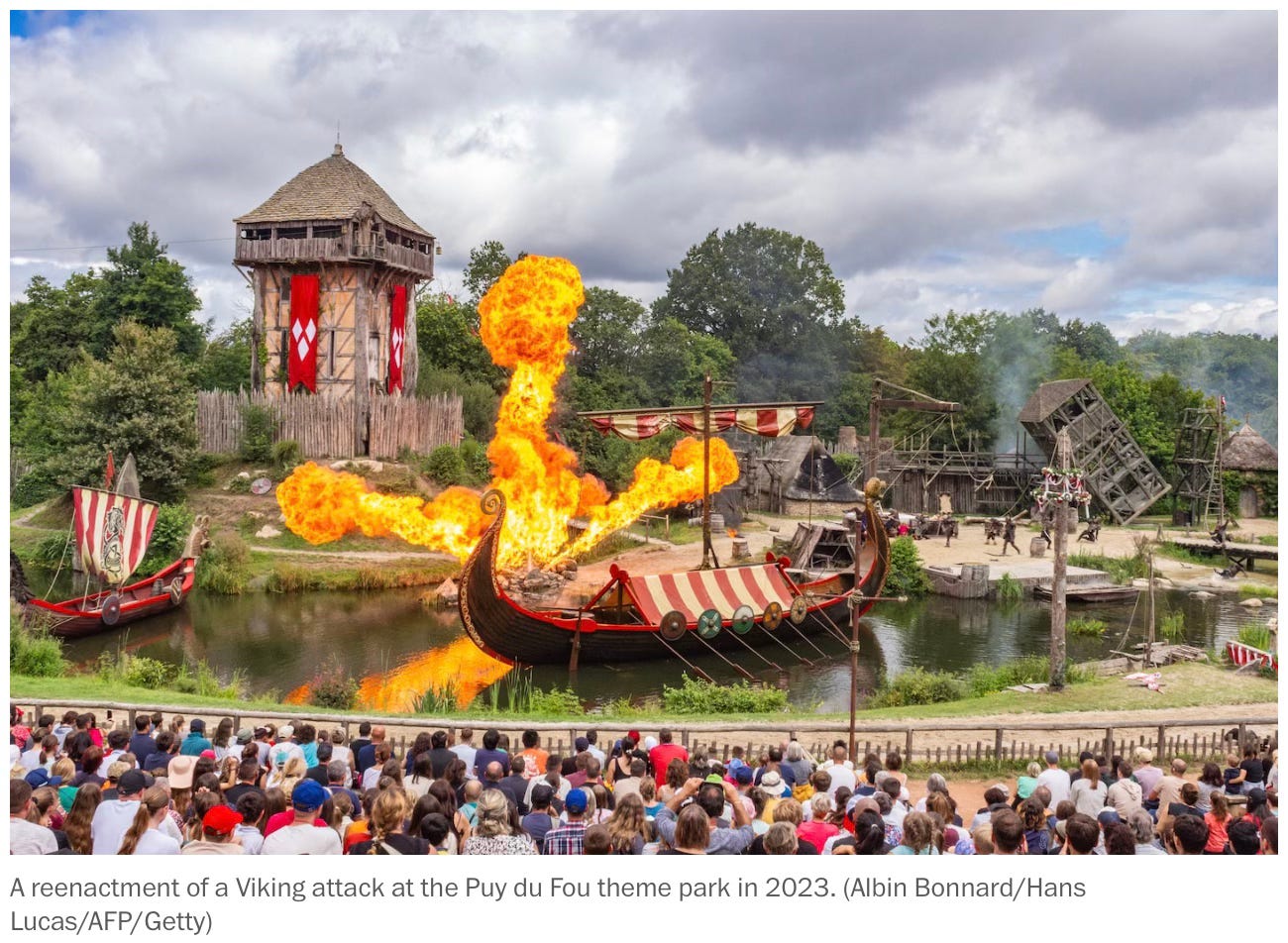
At Puy du Fou’s Viking-era village, families take selfies with warriors defending against raiders — Norsemen with axes and an appetite for murdering monks — in a display that resonates with contemporary anxieties about integration and identity. The parallels with the murder of Father Jacques Hamel in Normandy in 2016 by two Islamic State supporters are not hidden.
De Villiers has long been explicit about these connections, warning that France is on “the edge of the abyss.” The European Union finds itself increasingly unable to counter these narratives. Its technocratic language of regulations and directives struggles to compete with the emotional power of warriors for Christ. Brussels offers economic integration; Puy du Fou offers belonging.
Families visiting the park are seeking not just entertainment but also affirmation that their story holds the glory and honor that fairy tales can only mimic, that tells them who they are and, perhaps more important, who they are not. In the shadow of Puy du Fou’s medieval ramparts, the question isn’t whether Europe’s nationalist moment will pass, but whether the continent’s postwar consensus can survive it.
The thunder of hooves in the show that brings St. Joan back to defend France might be choreographed, but the political earthquakes they echo are all too real.
First published on 25 August 2025 in The Washington Post.

👏👏👏 A fascinating and well-written article, Tom! The popularity of the Puy du Fou is not at all surprising. It is a reflection of the rising nationalism all across Europe a Europe in reaction to globalization, European integration and mass immigration from the third world. All these trends have understandably causes a fear among the French people they will lose their distinct national, cultural and religious identity. The Puy du Fou theme park reminds them of who they are and where they come from and is a vision of what they want their future as a nation to look like.
The theme park reminds them of the glorious history of the French nation from the days of Ancient Gaul to the dashing knights in shining armor and beautiful queens of Medieval France to the pillaging and destruction of the Viking invaders (who are an allegory for criminal immigrants), to the glory of the French Empire to the unparalleled courage and determination of the French Resistance during WWII. For once, someone isn’t s****ing all over their country and it’s history. They can be proud of their heritage and be reminded of what makes France great. With hundreds of thousands coming to visit it from all over Europe even a couple French Presidents, and countries across Europe doing similar things to emphasize love of country and to give people in Europe a sense of national belonging and unity again.
The lesson the popularity of this park teaches us and the rise of nationalism all over Europe teaches us is that globalism and European Integration have their limits and that people in the West these days long for meaning, to hold on to national and cultural traditions and a shared patriotism that binds the people of a nation together. They also seek to maintain cultural and ethnic continuity and don’t want to be swamped by globalist cosmopolitanism and mass immigration from the Middle East and Africa. Nor do they wish to lose what makes them and their country unique or their distinct ethnic identity. They fear becoming part of one big gelatinous mass called Europe where they lose all the markers that make them are they are.
This is completely understandable and this is no longer a phenomena limited to the far-right but now spans the concerns of Europeans East and West, across the political spectrum. Every country has a right to maintain its indigenous people as the demographic majority and it’s culture as predominant in their own country. Brussels is also going to have to accept that European integration can only go so far and that it will never 100% be achieved. As Tom points out, the technical jargon of the EU simply can’t compete with stories of uniting in Christ or the heroism of the French resistance against the Nazi occupation. If the postwar consensus in Europe is to survive it must adapt to the times and the EU must accept that each individual European nation must have a degree of national sovereignty and must be allowed to stay true to its roots.
Great to know. Appreciating and learning from our history is important. The woke academics (legends in their own lunchtime) have, for too long, tried to obliterate and rewrite our history according to their own narrative. Great to know the French are rediscovering their history and identity.