


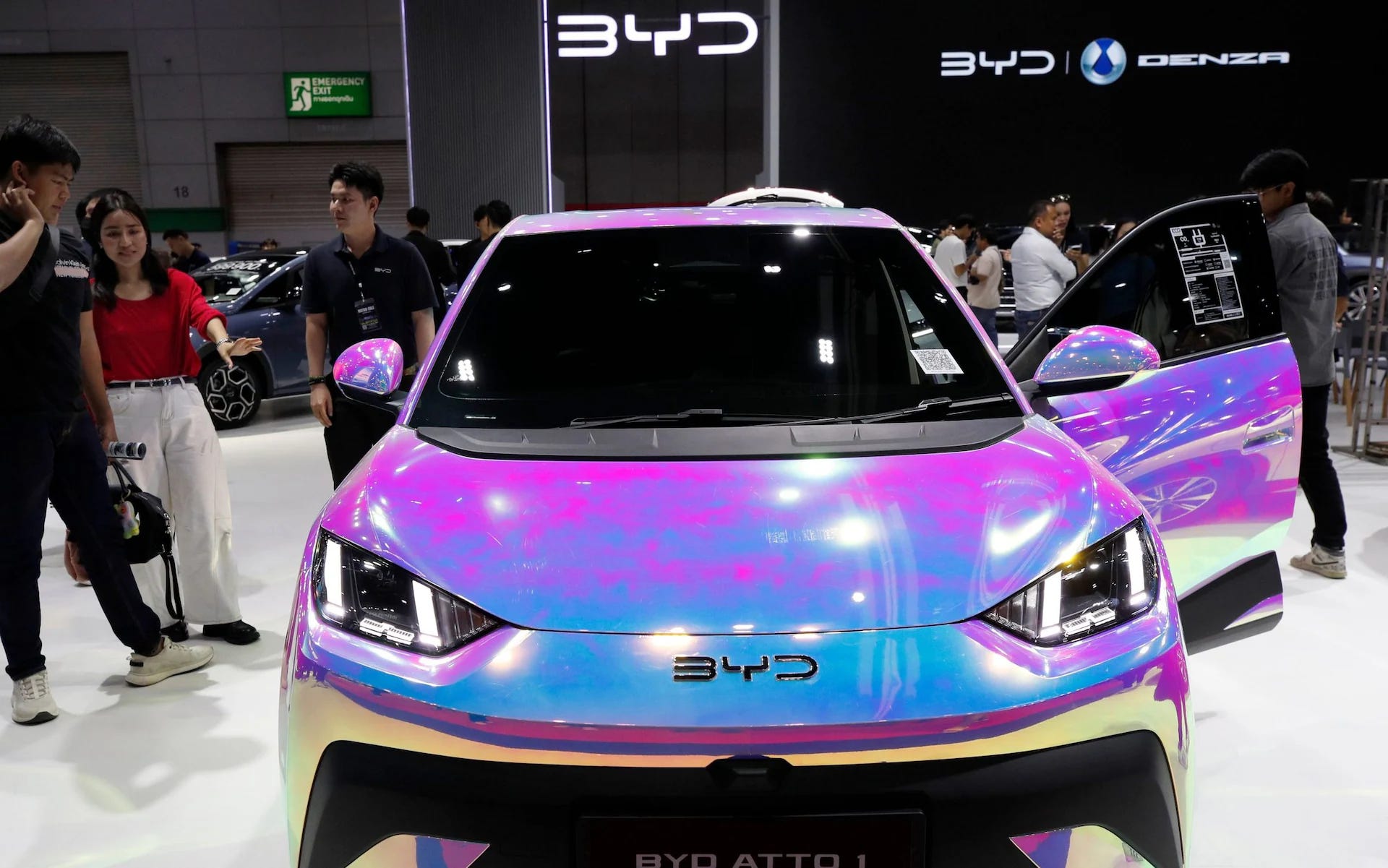
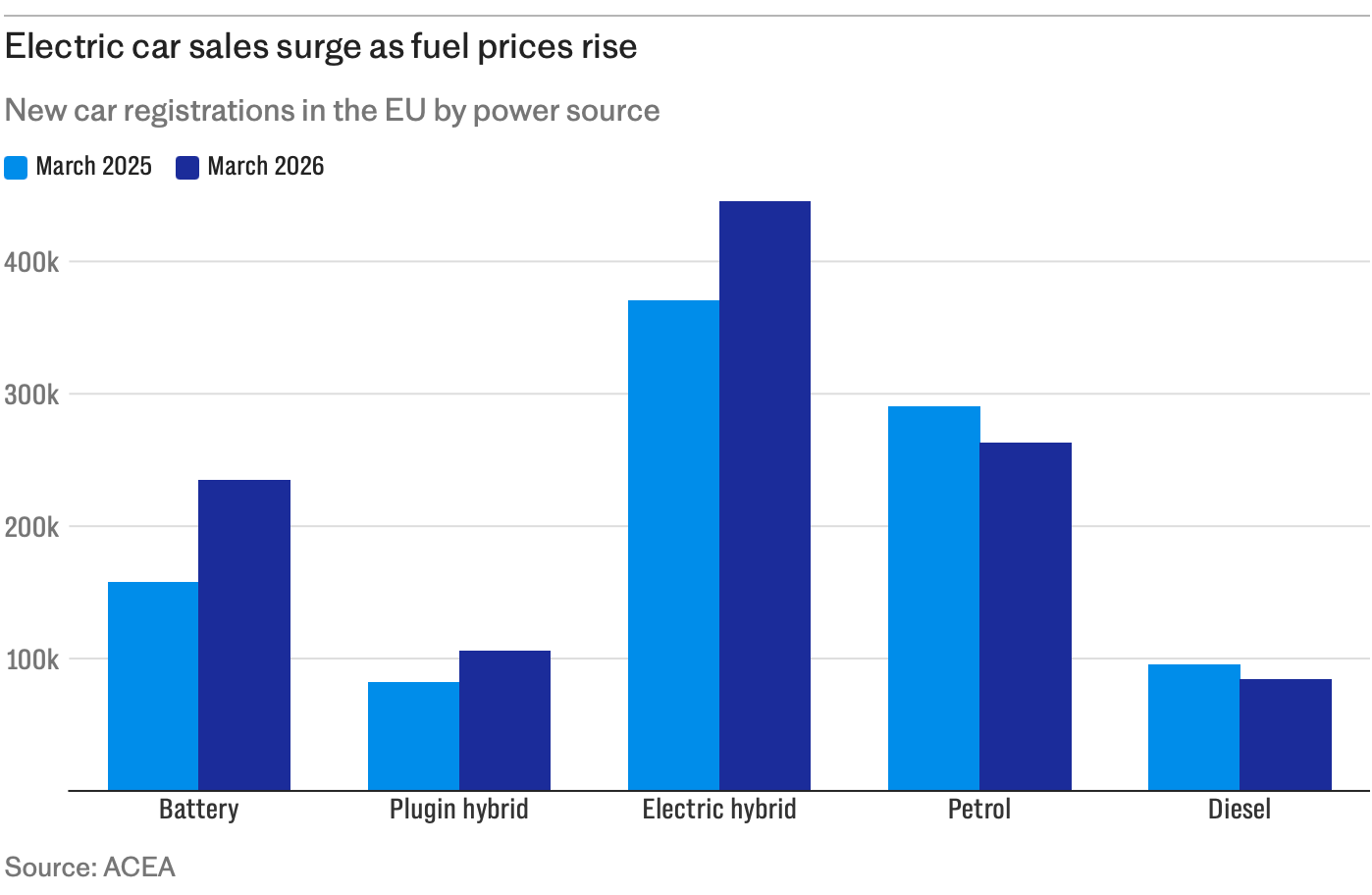
The snail-like migration taking holidaymakers to Cornwall this summer was a stark reminder of change. Pre-Roman technology lined the roadside, while the latest electric vehicles – now accounting for a quarter of all new cars sold in Britain – crawled along beside it.
That’s not all that’s changed. While many of the petrol and diesel cars stuck in the traffic were made in Europe, the drive to go green means that one-in-seven new cars sold in Britain is now made in China. Wolfsburg, Birmingham and Milan are being challenged by a technological revolution in the East.
While Europe’s bureaucrats predict the future with all the accuracy of Stonehenge’s druids, the sprawling industrial hub of Hefei, in China’s Anhui province, is already building it.
A “lights-out” factory is churning out electric cars as automated arms move with hyper-calibrated precision across a little-trodden shop floor. Operating at above a 90 per cent automation rate, there are few humans, so little light or heating. They’re not needed. There are also fewer mistakes and no days lost to strikes.
Production costs tumble as advanced software is integrated and rapid-charging battery systems are incorporated, pushing the purchase price down to a third less than a comparable European family car. It’s no surprise that ever more European parents are shepherding their kids in a product from China, not Germany or Italy.
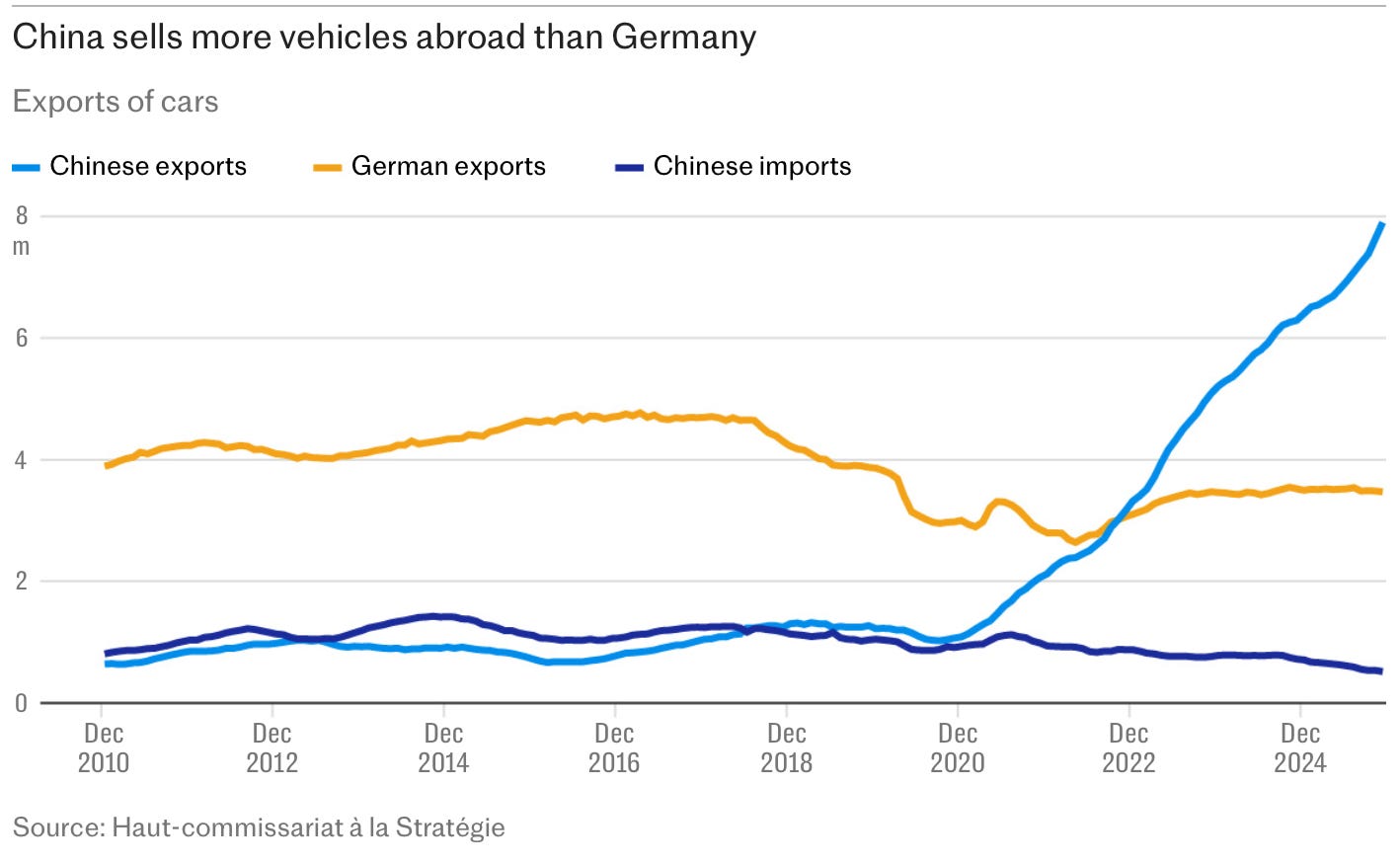
How did we get here? Only a few years ago Germany was outsourcing low-cost production to China. Now that’s over.
For three decades, European leaders chose to tell themselves comforting tales in three parts: In the beginning, the open global trade and strict domestic carbon mandates would steer the global economy toward market-driven efficiency; in the middle, Europe’s century-old lead in high-precision engineering was an insurmountable moat, so that in the end, China’s rapid economic rise would serve as a vast consumer showroom for foreign premium brands and a cheap shop floor for outsourced labour.
They were badly wrong. Each chapter has collided with reality. Europe is not facing a temporary cyclical downturn, but the consequences of complacency colliding with China’s strategic patience.
China hasn’t just caught up, it has leapfrogged the rest of the world, deploying capital on an industrial scale to carve openings in our economies and then reinforce its gains. Government support and competition between provincial champions, combined with dense supplier ecosystems, control of critical raw-material supply chains and a growing energy-cost advantage, have transformed China from a manufacturing laggard into the undisputed industrial powerhouse of the next generation – dominating electric vehicles, batteries and clean technology.
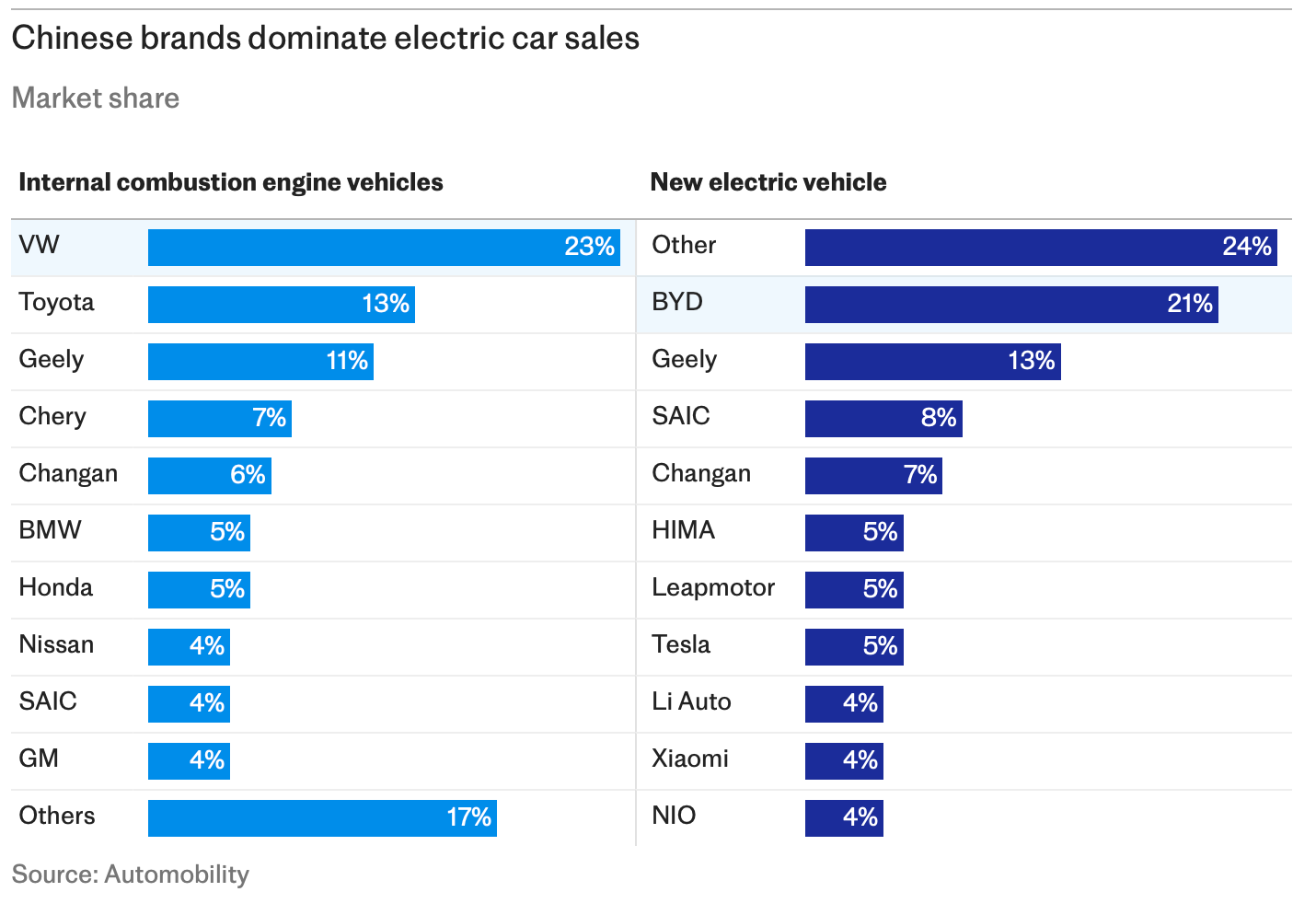
Battery systems account for about a third of an electric vehicle’s total cost. Chinese battery giants control the complete stack from lithium refining and precursor synthesis to cell assembly and pack integration. BYD alone operates as a single, hyper-integrated entity, making its own power semiconductors, battery cells, electric motors, and software systems.
That has transformed the model, it isn’t about cheap labour any more. Blue-collar wages in China are lower than in Western Europe but the human input into modern automotive manufacturing has shrunk dramatically.
What Europe faces today is far more serious. There is a gap in systemic industrial competitiveness and current policies are not helping this situation.
Western workers once earned their higher wages by generating greater productivity. That difference has largely vanished now modern Chinese factories deploy the same or better robotics and automated machinery than their European counterparts. In a global market, carmakers cannot afford to pay European workers two to three times more per hour than employees doing comparable manufacturing jobs elsewhere.
Vehicles aren’t just another industry. They are the power train of the continent’s manufacturing sector, accounting for more than 6 per cent of EU employment, 7 per cent of GDP and the bulk of industrial research and trade surpluses. That engine is stalling as Chinese auto-makers are taking the oxygen of foreign export markets and even encroaching into the Europeans’ own showrooms.
In market after market, from the UK, where Chinese brands achieved a 19 per cent market share in early 2026, to the emerging economies across South East Asia and Latin America, European legacy firms are losing volume while European leaders are losing their way.
In national capitals, defensive measures such as carbon-border adjustments risk turning a continent that once dominated global industry into a junior partner in an economic system increasingly shaped by others. Unless Europe and the UK respond to China’s corporate colonisation with energy reform and freer flows of capital, they risk becoming low-margin assembly outposts for foreign intellectual property – watching their factories fall silent and their industrial centres fill with jobless engineers and workers.
To fix this, Europe must tackle high energy costs and planning delays, stop competing on yesterday’s terms and start building for tomorrow.
To start, that means recognising that clean energy goals can’t be divorced from industrial vitality. Competitive, predictable power rates for upstream manufacturing, such as synthetic graphite, chemical processing, and battery cells, are essential to rebuilding the foundations of the new economy. Like China, we need both carbon-based and sustainable electricity production, including new nuclear power.
Next, we need to slash lead times. It takes about 200 days on average to obtain a non-residential construction permit in Germany, compared to just 40 days in China. That’s a tax on innovation.
Last, we need to aim for the future, not compete over the present. Mirroring established, high-volume chemistries like standard Lithium Iron Phosphate (LFP), will see Europeans fail. We should direct capital toward the next-generation technologies accelerating commercialisation of solid-state batteries, sodium-ion storage, hydrogen applications for heavy transport and specialised AI software architectures. By thinking of the future, not fighting for the past Europe, can build new competitive advantages.
European and British policy leaders have reached the end of one epoch and our challenge is how we face the next revolution. Failure to shift will see a continued, increased contraction of our continent’s manufacturing capabilities and a subservience to China’s manufacturing might. That’s not the right answer for our future or the world.
First published in The Telegraph alongside Veit Dengler 01 September 2026
It’s LOSING. not loosing.
Excellent piece. China has, through being strategically patient, radically overtaken a complacent legacy auto industry.
If the legacy industrial leader countries have a chance to once again become competitive it will be through leveraging academic institution spin out ideas both at pace and with a focus on technology leaps.
One great one that there is still space to leverage is bidirectional battery use. Who needs a battery for your (powered by renewables) home if your EV can store the power? (Assuming, of course, that your EV is as rarely out of your driveway as so many domestics vehicles are).