


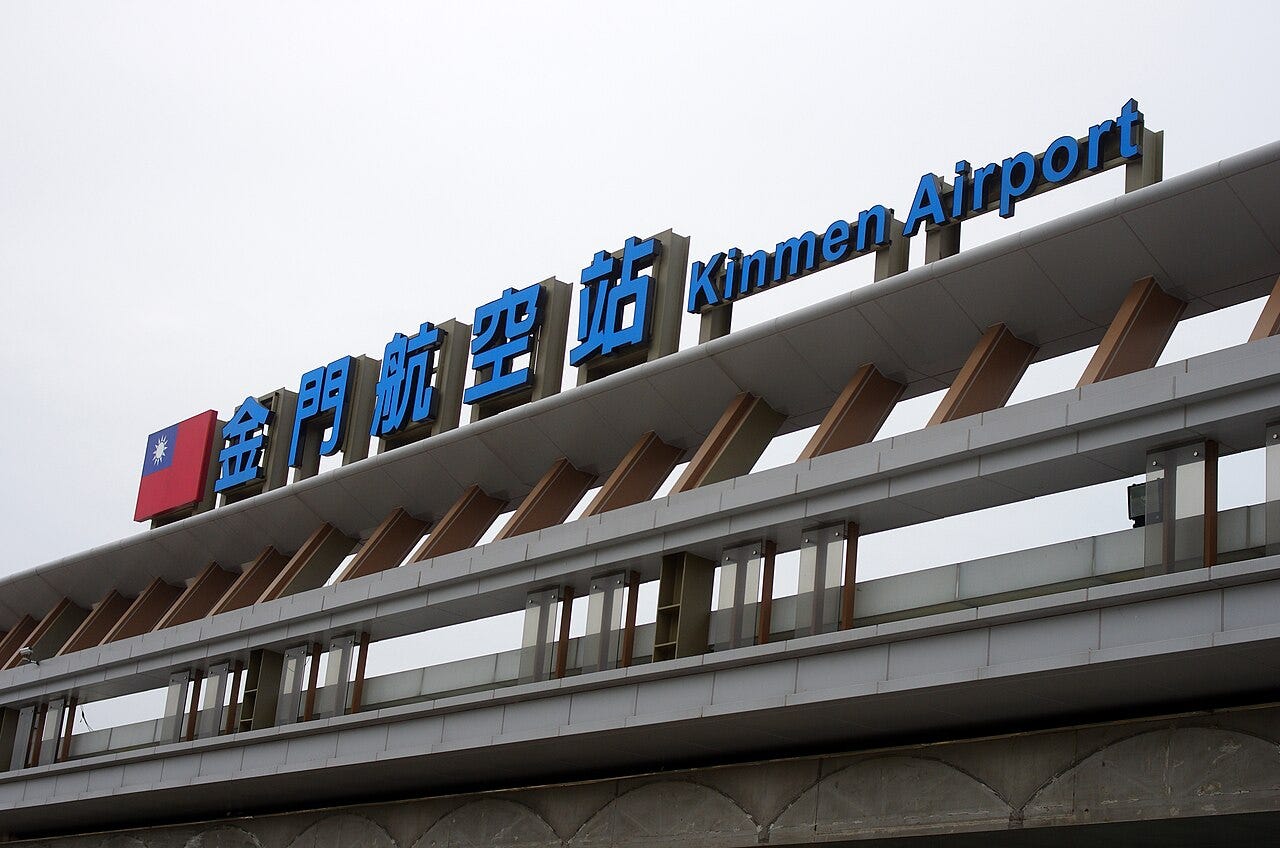
There’s an airport in Asia almost nobody has heard of, being built next to a city most people won’t know, and sits opposite an island that has been forgotten by many – but it tells us everything we need to know about Communist China’s ambitions.
Kinmen Island is known for its seafood and rural calm – it’s very peaceful compared to so many other parts of the region. It is home to some 150,000 people who remained loyal to Chiang Kai-shek, the nationalist leader, when the Communist Red Army swept through China during their civil war. That means it is part of Taiwan, as the Republic of China is commonly known. It has its own small airport.
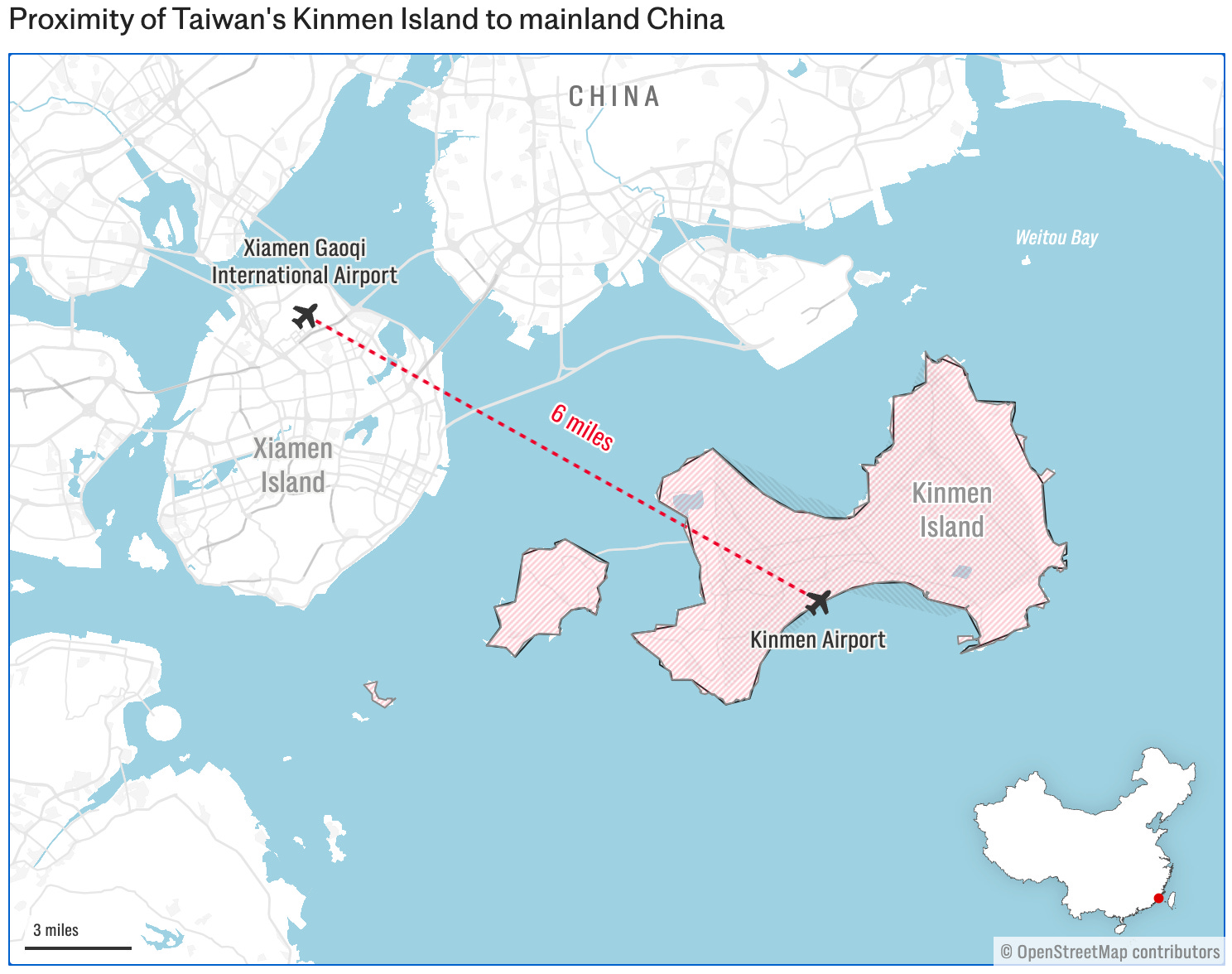
Just a few miles of sea across from Kinmen is the Chinese city of Xiamen. There, the new airport is being built. That’s not surprising, for Xiamen’s population of five million is growing and their current airport is not fit for purpose. The new international hub will have three runways and is expected to open later this year.
This is where the trouble starts, because this isn’t a story about infrastructure but about power and how the People’s Republic of China is using development to bully the Republic of China (Taiwan).
It’s a warning to, and a reminder of, what’s really at risk with a global power shift to the Middle Kingdom.
Why? Because Beijing isn’t playing by the rules, it’s exploiting them.
It’s not unusual to have two civilian airports six miles apart, nor to have overlapping airspace. But there’s a well-understood solution to the challenge: share data, agree procedures, and set up a hotline.
Taiwan’s civil aviation authority has been asking to do just that for years, but it has been ignored.
In 2024, China went further and unilaterally activated new commercial routes, thus cutting the buffer between the two sides’ aircraft to about a mile. That’s dangerous, but it’s not a coincidence.
The refusal to coordinate is not an oversight in the project. On the evidence, it is the point of it. This isn’t about deconflicting airspace, it’s about conflicting sovereignty.
Seeing the construction from the bridge of a Taiwanese customs cutter tells you more about how Communist China intends to treat the rest of the world than any speech Xi Jinping has ever given.
The Kinmen playbook is repeated widely. Chinese coast guard ships ram and water-cannon Philippine vessels resupplying a garrison inside Manila’s own exclusive economic zone. Fishing militias form floating barriers miles long. Military jets harass Taiwanese aircraft, including a medical evacuation flight near Kinmen last year.
Earlier this month a Chinese nuclear submarine fired a ballistic missile about 4,500 miles into the South Pacific Nuclear Free Zone, which was established by a treaty whose protocols China signed in 1987. New Zealand received a few hours’ warning and the United States, Taiwan, and Japan received none. You don’t have to be a hawk to find that threatening.
So what’s behind it? Why is Xi looking at a world that buys his country’s goods and supplies so much of its food and fuel, and choosing aggression over co-operation?
Beijing’s rulers are mirroring the structures abroad that they have lived with at home, and the friction between that authoritarian model and our own is causing tremors.
Every empire inherits the roads and rules its predecessors built. Today’s world, created from the ashes of 1945, is, by historical standards, strange. The winners didn’t choose to extract tribute but to export hope.
Democratic accountability, open trade, and rules instead of force were all part of ensuring the capital got rich by seeing the satrapies prosper.
The UN and global institutions were created to share power under the norms we, the victorious powers, made. China, then governed by the nationalists, was a founding member.
You can see the success all around us. With notable exceptions, the world has been more prosperous and peaceful in the past 80 years and few have profited more from the system than the People’s Republic of China.
But Beijing now looks like it wants to destroy the platform on which its wealth is built and instead return to the old style of empire that Xi’s predecessors in the Forbidden City would have recognised: tribute and subservience, not cooperation and engagement.
Just look at Hong Kong. Despite the guarantee of “one country, two systems” until 2047, in a treaty lodged with the UN, Xi has turned the city state into a state-run city. “One country, one system” was made complete by the National Security Law in 2020.
China’s rulers are trying the same central control across the UN system.
Taiwan attended the assembly of the International Civil Aviation Organization (ICAO) as recently as 2013, and the World Health Assembly until 2016. Beijing has since forced it out of both. That makes no sense, except as a display of power.
Excluding an island that sits on major air routes from the world’s aviation safety body makes Chinese airliners less safe too. And excluding Taipei from the global Covid response when it was one of the first to act endangered the whole world.
When a policy harms its own author, it’s not about safety or efficiency. These decisions are about erasing Taiwan from international life, whatever the cost.
Exclusions of Taiwan are based on the so-called “one China” policy that supposedly ties our hands. The idea, repeated at every opportunity by Beijing, is that there is only one Chinese state and that Taiwan is a renegade province.
In 1972, Britain acknowledged Beijing’s position that Taiwan is a province of China. Taiwan, which held China’s seat at the UN until 1971, does not claim to be independent but to be the legitimate Republic of China – not the People’s Republic governed from Beijing.
But words in communiqués are chosen by lawyers for a reason. So we “acknowledge”, we do not “recognise”, and we do not “endorse”. We do not agree with Beijing and we do not disagree; we take no position.
But we also trade separately with Taiwan, recognise its passports and officials, and engage with it on security and technology. Our conversations with Taipei are not brokered through Beijing.
That is not unusual. In other disputes, we acknowledge one side’s position to work with them where we can without conceding a point – whether or not we share it, even in Europe. The EU holds the position that all European states may join it. Brussels aspires, openly, to a one-Europe policy. They’re free to do so, but that didn’t stop us leaving.
And unlike Britain, which once fell under the Roman Empire, one fact is worth stating plainly: the People’s Republic has never governed Taiwan. The Dutch, the Qing, the Japanese and Chiang Kai-shek’s nationalists all have. Communist Beijing has not, even for a single day.
Still, the Chinese Communist Party is trying, through propaganda and aggression, to make the result feel inevitable. That is hard to square with reality.
Two pieces of history and a few basic facts make the fatalism premature.
In October 1949, Xi’s hero, Chairman Mao, landed thousands of troops on Kinmen’s beaches at Guningtou. Within three days the force had been destroyed. In 1958 nearly half a million shells fell on the island in six weeks, and it did not fall. Kinmen’s blacksmiths still forge the casings into kitchen knives and sell them as souvenirs. Deterrence at that particular spot has held for more than 75 years.
Since then, China has hardly become more united. The central control of the Mao era has given way to corruption on a scale that sends the children of the elite – Xi’s daughter among them – to be educated at Harvard. There they live like princes while Xi’s government arrests its own military commanders for theft at home.
There are suggestions that what troubled Xi was not the theft itself, since so much of the state is on the take, but the discovery that the generals, like Russia’s, had left the military denuded.
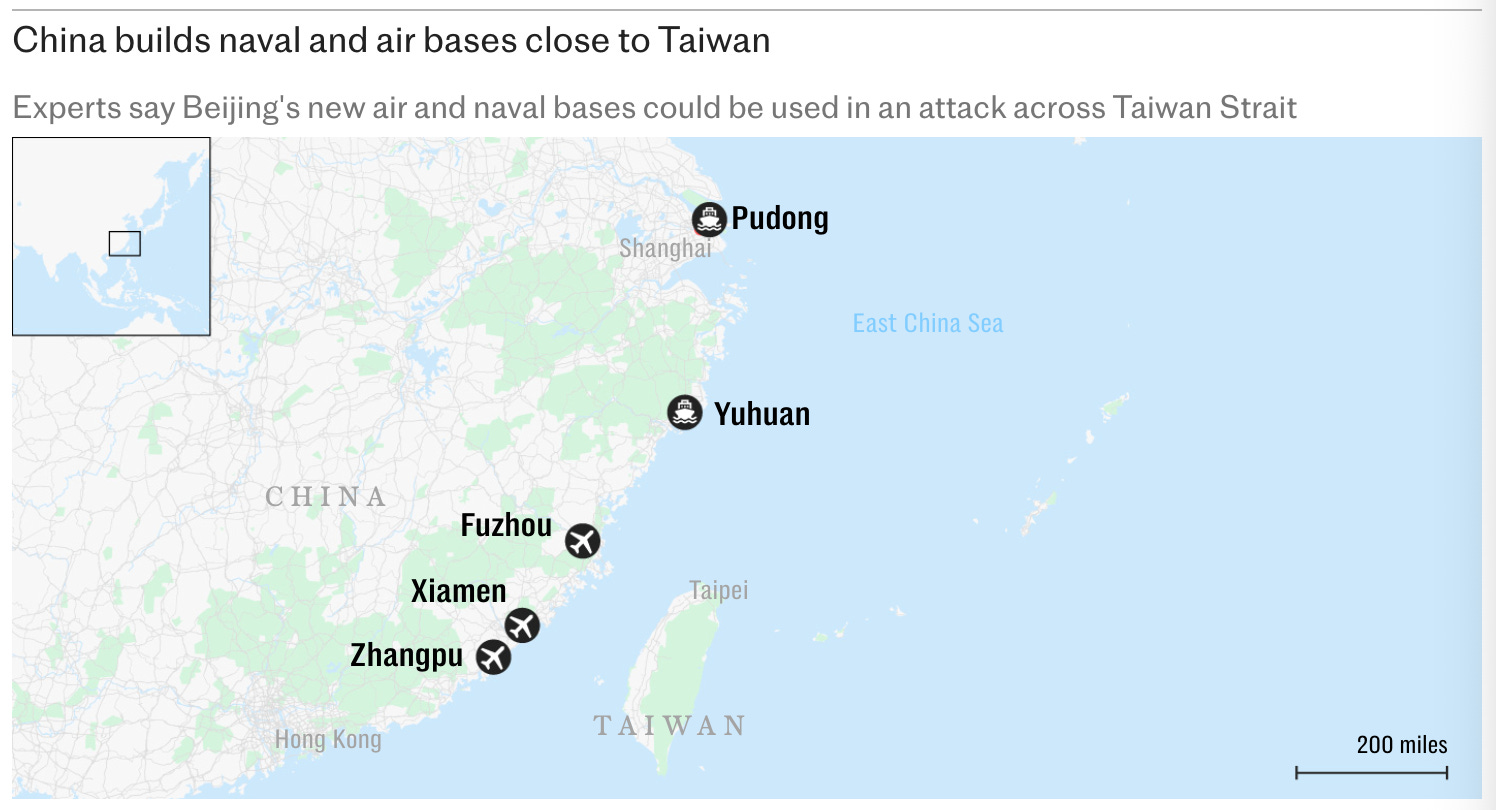
Any invasion of Taiwan would be hard enough – a 100-mile crossing of rough seas on to the few beaches suitable for a landing, perhaps 14 in all, with every one of them prepared.
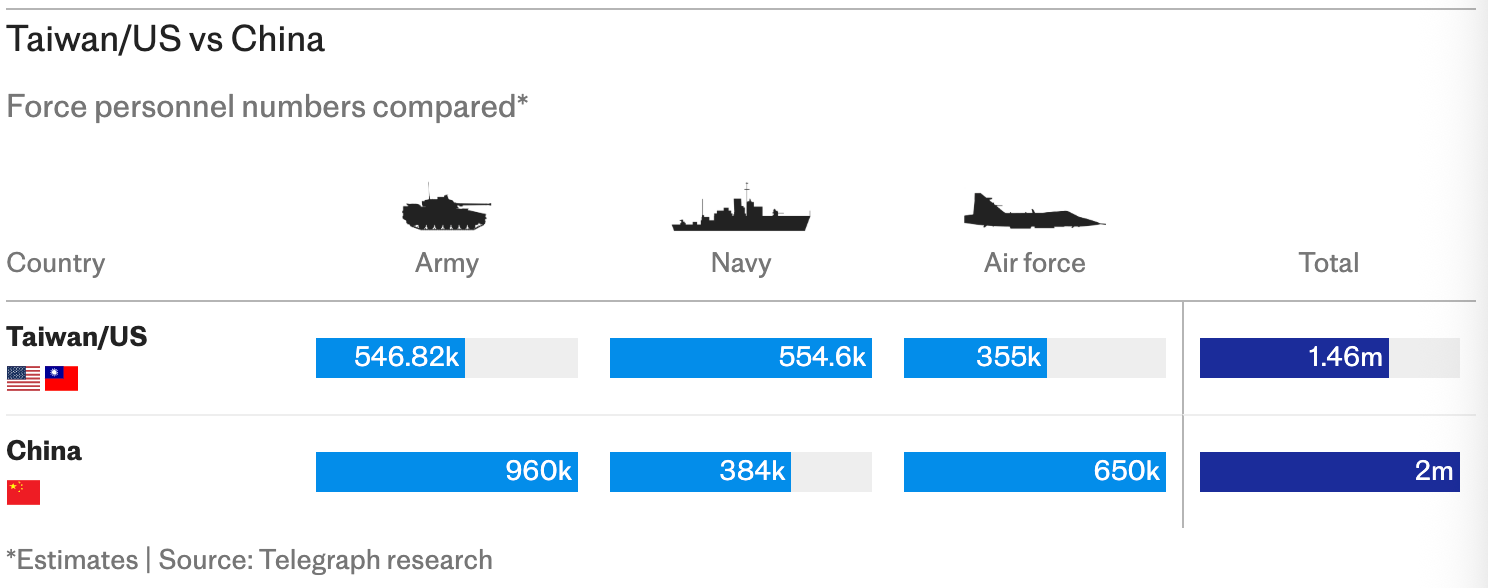
The truth is that Beijing’s aggression is self-defeating, but recognising that truth is not comforting. An empire run Xi’s way rather than ours would make us all poorer and life harder for everyone, and still they press on.
Chinese communism impoverished and killed on a vast scale. It was not communism that lifted 800 million people out of poverty; communism put them there. Prosperity arrived when Deng Xiaoping opened the country in 1978 and joined the institutions of the free world that the Party now undermines.
Powers that set fire to the ship that saved them tend to regret it. The Mongols smashed the qanats that had watered Persia for a millennium. Historians argue about how much of the region’s decline to lay at their door, but no one argues that Merv recovered. It is still a ruin.
This is not about remote cities lost to history, but about us today.
In the South Atlantic, Chinese fleets are harvesting so many fish that they are making marine deserts, just as they did in their own waters. And the organisations we created for everyone’s benefit are being twisted for political gain. At one point Beijing’s officials simultaneously ran four of the 15 UN specialised agencies – more than any other country – and that is before you count the client states that vote as directed.
Consider what that capture already costs us. When Britain’s own government hunted for reasons to surrender the Chagos Islands, its central excuse was that the International Telecommunication Union, an agency run until 2022 by a Beijing nominee, might one day be used to challenge our control of the spectrum that keeps Diego Garcia operating.
I said at the time that the argument was baseless, and it is. But notice what it reveals: capture the institutions and you win battles you never have to fight.
The mere shadow of bodies Beijing has bent was enough for a British government to talk itself out of British territory. Taiwan’s expulsion from ICAO, an agency then also led by a Chinese official, worked the same way. Of course it did.
Since then, Taiwan’s president wanted to fly to Eswatini, one of the countries with which it maintains full diplomatic relations, but Mauritius denied access to their airspace.
It’s hard to square the British government’s position on the continued security of the Chagos Islands with the would-be owners’ acquiescence to Beijing’s demands to disrupt Taipei.
That’s why the airport near Kinmen is not a lesson for Taiwan alone, but for us all.
So it is about time we made a few things clear. Britain takes no position between Taipei and Beijing on Taiwan’s final status, and nor should we. But taking no position is not the same as letting one side bully us into making its claims real.
Our one China policy does not commit us to rejecting Taiwan’s participation in ICAO or the World Health Assembly. Both are matters of safety, not politics. And the island-building, life-threatening attempts to intimidate Pacific democracies are a threat not just to them, but to all of us.
None of this is provocative. It is simply declining to let someone else exploit the benefits we built while denying them to others, and insisting on defending the true meaning of our own words.
The airport off Kinmen shows what happens when nobody does.
👍!