


I spoke to the Conservative Environment Network on 15 June 2026. The text of the speech is below.
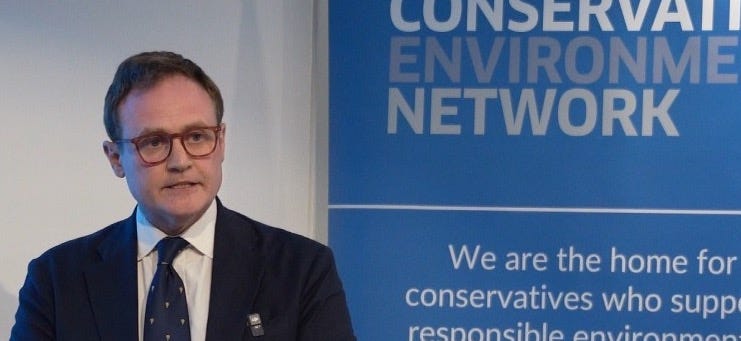
Thank you very much for inviting me to speak to the Conservative Environment Network. I’ve been part of this group for nearly a decade, and it’s a pleasure to be here, particularly with Sam’s family in the front row. Sam was there when I first joined, and he was an inspiration to me. I’m very glad to have the chance to pay some respect back by being here tonight.
It’s also a pleasure to speak at a time when security and defence are at the forefront of people’s minds. Yet that is precisely why the task Sam left us has become more difficult. Across the country, the foundations of environmental policy are being challenged. Many people feel that Britain is holding itself back with policies that others ignore.
This government has abandoned multilateral environmental action and embraced something closer to unilateral economic disarmament. Instead of leading the way, we are punishing our own households and businesses with higher costs and fewer opportunities. Rising energy prices are closing factories and driving investment overseas.
Now, with risks mounting on every side, we need to be honest about what has worked and what has not. In doing so, I draw inspiration from Sam’s favourite phrase and the pen name he used: “Repairing Lease.”
The phrase came from Margaret Thatcher, and Sam quoted it often:
“No generation has a freehold on this earth. All we have is a life tenancy—with a full repairing lease.”
That idea deserves a moment’s reflection.
A repairing lease is not about preserving a museum. It is about living in a home. It does not require us to leave everything untouched. It asks us to enjoy what we have inherited, to make full use of it, and to ensure that when our time is up, we leave it in better condition than we found it. The roof repaired. The walls painted. Something stronger and better for the next generation.
That is at the heart of Conservatism.
Sam understood that conservatism and conservation share the same root. But he also understood that stewardship is an active duty. His environmentalism belonged less to the curator than to the builder. You honour an inheritance by improving it, not by locking it away.
Somewhere in recent years, we lost sight of that.
We forgot that our task is to repair and improve. Instead, we began to worship scarcity. We treated refusal as virtue and self-denial as wisdom. We wore hairshirts while failing to develop the technologies that could genuinely reduce emissions. The result is that we are losing support for environmental ambition and failing to create the opportunities that would make a cleaner future possible.
No one wants their children to inherit a more polluted or unstable world. But nor do we want to deny them the opportunities we ourselves enjoyed. The answer must be investment, innovation and growth—creating the wealth that allows us to pay for the repairs we owe future generations.
Tonight I want to make that case in three parts:
The scarcity we have chosen.
How that scarcity has prolonged our dependence on carbon fuels.
The cost this choice is imposing on Britain’s future prosperity and security.
The remedy, I believe, is simple: remember that liberty creates opportunity, opportunity creates innovation, and innovation creates abundance. Throughout history, greater efficiency and cleaner technologies have emerged not from restriction, but from freedom and invention.
In short: take off the hairshirt, get out of the way, and let abundance flow.
The Politics of Scarcity
For too long, environmental policy has become a policy of constraint rather than transition.
Government has legislated against development and piled obstacle upon obstacle in the path of construction. Those who want to build cleaner energy infrastructure, modern transport systems or new technologies carry the entire burden of innovation, while regulators face no obligation to account for the cost of inaction.
The result is predictable. The default answer becomes “no”.
Projects that would cut emissions and strengthen our resilience become trapped in planning disputes and legal challenges. Nuclear power stations are delayed. Infrastructure is stalled. Investment is discouraged.
We see the consequences everywhere:
New North Sea exploration has been banned despite repeated energy crises.
Britain imports energy we could produce ourselves.
Small Modular Reactors are promoted abroad while deployment at home lags behind.
Onshore wind was effectively blocked for much of a decade.
Coal is imported from overseas after domestic production is rejected.
This is not transition. It is rejection.
We are not moving from one source of power to another. Too often, we are simply choosing less power.
History tells a different story. Britain moved from wood to coal, from coal to oil, and from oil to nuclear not by consuming less energy, but by making energy cheaper and more abundant. Every major transition in human history has been driven by abundance, not scarcity.
Yet somewhere along the way, environmental policy stopped being rooted in science and became something closer to a moral creed. Prudence became restriction. Stewardship became abstention.
That is profoundly un-conservative.
Conservatism is a partnership between the dead, the living and those yet to be born. It requires investment in the future. It requires us to plant trees under whose shade we may never sit, and to build infrastructure our grandchildren will use.
Let me be absolutely clear. I am not arguing that all environmental regulations are wrong. Rules have an important place in a thriving economy.
But a system that treats construction as destruction and inactivity as virtue cannot deliver the industrial transformation we need.
The Carbon Illusion
Environmentalism should be about reducing emissions. But it must reduce emissions in reality, not merely on paper.
Britain’s domestic emissions have fallen dramatically since 1990. That is often celebrated as a major success.
Yet the picture changes when we look at consumption emissions—the carbon embedded in the goods we import.
Much of the carbon we claim to have eliminated has simply been outsourced. Factories have closed here, only for production to move overseas to countries with lower environmental standards and higher emissions.
The environment does not care whether carbon is emitted in Scunthorpe or Shanghai.
Indeed, many of the facilities replacing British industry are less efficient than those they replace. We close a plant here and production continues elsewhere with higher emissions. Jobs are lost. Carbon rises.
That is not environmental progress. It is self-deception.
The closures of Port Talbot, Grangemouth and the decline of firms such as Denby Pottery all illustrate the same problem. Demand has not disappeared. Production has simply moved elsewhere.
Britain still consumes steel, fuel and ceramics. We now import them instead, often at higher environmental cost.
The lesson is straightforward: the choice is rarely between energy and no energy. More often it is a choice between cleaner energy and dirtier energy.
Too often we have chosen the latter while congratulating ourselves on the former.
The Cost to Britain’s Future
There is a deeper consequence still.
The technologies that will define the future—nuclear power, fusion, long-duration storage, hydrogen, advanced computing and artificial intelligence—depend on one thing above all else:
Cheap, abundant energy.
Without it, innovation becomes uneconomic.
China’s investment in solar power has succeeded because scale drives costs down. Engineers know this principle as Wright’s Law: the more you produce, the cheaper and better a technology becomes.
The same principle applies to AI.
Britain has the talent. Britain has access to capital. But we struggle because we lack affordable power.
Data centres, advanced manufacturing and future industries all require enormous amounts of electricity. Countries that can provide it cheaply will prosper. Countries that cannot will fall behind.
The politics of scarcity is now undermining public support for climate action itself.
Across Europe we have seen protests, political backlashes and growing scepticism. Public concern about climate change has fallen not because the science changed, but because the costs have become more visible.
A strategy based on sacrifice is inherently fragile. The moment economic pressure increases, public support evaporates.
A strategy based on abundance is different. It survives difficult times because it lowers bills, strengthens industry and improves living standards while reducing emissions.
That is the path we should choose.
Security and Environment Are the Same Challenge
Energy security and environmental progress are often presented as competing priorities.
In reality, they are usually the same priority.
Every barrel of oil and every cubic metre of gas we import creates a dependency on someone else’s infrastructure, someone else’s politics and someone else’s decisions.
Producing more energy at home is not only cleaner. It is more secure.
Recent crises have demonstrated the vulnerability of global energy markets. Britain remains heavily exposed to external shocks. We import record amounts of electricity and remain dependent on international supply chains that we do not control.
A resilient nation requires resilient energy.
NATO now identifies secure energy supplies as one of the foundations of national resilience. Sovereign AI, sovereign steel, sovereign manufacturing and national defence all depend on reliable, affordable power.
A cleaner future and a more secure future require the same thing: abundant, low-cost energy.
A Conservative Environmentalism
This brings us back to Sam’s insight.
Abundance, growth and stewardship are not competing ideas. They are partners.
Responsibility and innovation go together.
A cleaner world and a richer world are not contradictory goals. They are mutually reinforcing. The same markets, the same innovation and the same freedoms that generate prosperity can also deliver environmental progress and national security.
The alternative is a politics of symbolic sacrifice that delivers little while costing a great deal.
Instead, imagine a different future:
Cheaper, more plentiful power.
Stronger manufacturing.
Faster innovation.
Greater investment in clean technologies.
Lower bills for households.
A cleaner environment.
A more secure Britain.
That is the Conservative environmental vision.
Not direction, but choice.
Not constraint, but abundance.
Not conservation through restriction, but conservation through innovation.
A repairing lease asks us to leave the house in better condition than we found it: strong walls, a sound roof and clean, abundant power running through the wiring.
That is what stewardship means.
And as Sam never tired of reminding us, we hold this country on a full repairing lease.
It is time we remembered what that responsibility—and that freedom—truly demands.
Thank you.
An excellent speech and at a high contextual level where few of any political, economic, or environmental viewpoint would disagree with you.
Would that more who are in a position of political leadership spent more time first ensuring we can all get aligned at such a contextual level. Unfortunately, though, all too often they leap into tactical points scoring and bashing of their opposition. Yes, to some extent that is the "game" part of politics", so I am simply hoping (always) for more politicians to think as "cathedral builders" or, as you put it, planting trees that they will never see grow. A statesman thinks of the next generation, etc.
Your psychopath in the White House canceled solar and wind projects, which are free renewable and green energy and work great, and the rest of the world is not lagging behind as we are. And by the way, technology exist to run data centers without the extraordinary heat, electricity use and water wasted and impact on the environment. Consult the experts at MIT. Even the use silicon is not necessary anymore, but you know how you guys are about science, so. Just stop whining about it, because oil is a finite resource, Which is why the Middle Eastern countries have been diversifying their energy portfolios.
Capiscimi?