


On a flight to Afghanistan many years ago, I found myself sitting next to a young imam who had just joined the Army. We were on our way to fight for our country in some of the toughest theatres of combat our forces had seen for decades. We both knew the risks—even for those in camps that were regularly mortared, let alone those like him who would engage with tribal leaders and risk everything to try to avoid fighting.
I knew that for him, this wasn’t just a one-front war. When he went home, many who had thought of him as a friend would now view him with suspicion. His community in Bradford was hostile to his actions; many saw the Taliban as Muslim brothers first. That’s not how our partners in Turkey or the United Arab Emirates saw such a twisted death cult. And it’s not how he saw them either.
He knew he would face hostility at home from extremists, and that even his family would be at risk. It was a long flight, so I asked him why he was doing it.
He looked at me and said quietly,
“It’s not your son who risks being radicalised by these bastards. It’s mine.”
That moment has stayed with me. It captured a truth we’ve all seen but too often failed to recognise: extremists who claim to champion a group must first enslave them.
In Northern Ireland, the IRA targeted Catholic police officers first—to silence its critics and pretend that only the path of violence, not coexistence, could win. Today, Islamists are silencing their families and neighbours first, denying those who rightly see themselves as British the chance to live in peace.
Extremists who claim to champion a group must first enslave them.
That’s bad enough. But seeing those fellow travellers who speak only to bloviating, self-appointed community leaders merely reinforces extremist control. That’s what we’ve witnessed on the marches. Those who claim solidarity with a community by aligning themselves with its most extreme voices are fighting for control and weaponising division. They suggest that ordinary British Muslims should have no voice except from those preaching repression and hate—just as the left-wing idiots who once claimed the only people who truly spoke for Ireland were the IRA, despite every election showing the opposite.
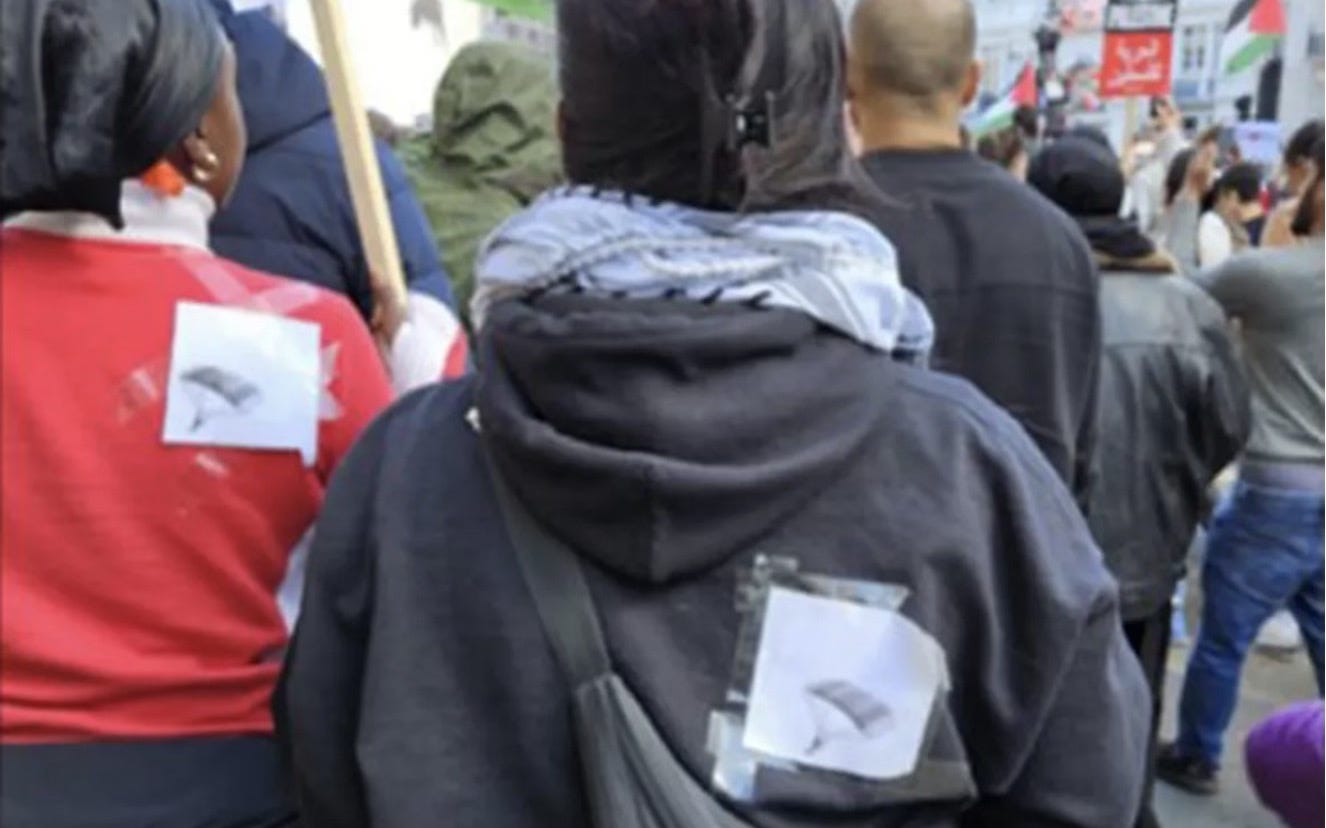
I’m not alone in seeing this. After the 7 October attacks, Muslim parents watching the protests in London and Manchester told me the same story. They saw acts of intimidation and symbols of aggression and division they would never tolerate at home being openly displayed on the streets.
Instead of arresting the intimidators and haters, the police just watched them go by. In meetings in the Home Office and around the Cabinet table in Number 10, I spoke about these symbols. After decades working in the Middle East, serving alongside courageous Muslim soldiers, and studying Islam and Arabic, I recognised them. It’s true that some symbols of violent extremism can be normal in other circumstances. Context matters.
But what we saw on the streets was not the equivalent of the Hindu symbol of peace and good fortune used for centuries, but the hateful swastika stolen by the Nazis and used to spread fear. Still, as people waved and chanted in front of the cameras, the police stood by. Across the UK, Muslim parents who had done all they could to protect their children from such indoctrination were seeing it broadcast into their homes—normalised and seemingly encouraged by a silent police force. Parents contacted me, terrified that their children would be seduced by the idea that this tribal identification and hatred was normal, even justified.
When the police look away, it is the loudest, angriest voices who set the moral tone and write the law.
That’s a betrayal of those families and the brave police officers who risk their lives daily. Worse, it’s an erosion of the freedoms we all share. But our police leadership has failed—not in the response to Manchester but in the paralysis before the politics of division on our streets. Our institutions have flinched.
As the police commander on the ground, securing a peaceful protest may seem the right answer. That’s how you avoid trouble on the day. But if that protest sees individuals frightened, families torn apart, young people radicalised, and our society fractured, that peace is an illusion, bought at a very high price. Those who tolerate hate are destined to reap its harvest.
Consider what happened in Birmingham. When Maccabi Tel Aviv’s football team was due to play there, local authorities banned the visiting fans because of the threat posted to them from protesters. That’s not a security decision; it’s surrender. Rather than protect the right of people to attend a sporting event, our institutions chose appeasement. The message was clear: if you threaten enough violence, you get to decide who can visit our cities and who cannot.
This is how extremists win—not by overwhelming force, but by exploiting our institutions’ cowardice. Every capitulation teaches them that Britain’s tolerance and freedoms can be weaponised against itself. Every time we allow the threat of disorder to determine what can and cannot happen in our cities, we hand control to those who traffic in intimidation.
Those who tolerate hate are destined to reap its harvest.
That’s why this calculation should be made by those elected to do so, and they should be held accountable for the result. But that isn’t what happens. When ministers, including me, urged police to act against open incitement to hatred, the answer was that ‘operational independence’ prevented intervention.
Operational independence was rightly meant to stop governments ordering arrests for political convenience, not to stop governments protecting the public from extremism or silencing those elected to determine when action now would prevent worse problems being stored up for the future.
The result is a dangerous inversion: police officers end up making political choices while politicians are left pretending they have power but in reality have none. That is not democracy—it’s an institutional coup.
And the result? We all now know the price of this failure.
As so often in history, the Jews suffer first. The antisemitism we have seen rising should not just terrify them but serve as a clear warning to us all: the Jews were the first targets, but never the last. If we don’t stop this spread of hate, we will all suffer.
While families across the country mourn the two courageous men who died protecting their synagogue, they are not alone in feeling fear. Muslim families fear their children are being radicalised. Jewish families fear for their children’s safety walking to school. And everyone is fearful that this division could spread.
To those who join the demonisation of Jews by pretending Israel is uniquely evil, this distinction means nothing—but it should mean everything to the state. Instead, our institutions have traded tomorrow for a quiet today, an abdication of moral authority, and a growing silence where the law should speak.
After the first targeted murder of Jews in Britain since families were expelled in 1290, we need to wake up.
Hatred does not vanish when ignored. It metastasises. It adapts. It cloaks itself in the language of each new age, using words like resistance, liberation, and justice—but its heart remains the same. This is what a globalised intifada looks like. Those who call for it are not a distant echo of Gaza; they are threatening our own moral order, here at home.
We need to face this challenge and ensure ministers have the power to act and can respond. That doesn’t mean ordering arrests, but it means getting beyond the mantra of operational independence to a shared understanding of the political implications of tactical decisions. It means clear expectations, transparent oversight, and real consequences when those priorities are ignored.
Otherwise, hatred will continue to find cover in our hesitation. Every time the police waver and the law against incitement or intimidation is allowed to sit silent, extremists learn that Britain’s tolerance can be weaponised against itself. Every time we ban an event rather than protect it, we teach them that threats work.
The young imam on that flight understood this better than many who sit in power in the police or government today. He joined the Army not because he wanted to fight other Muslims, but because he wanted to protect his own children from those who would twist their faith into violence. He knew what too many of our institutions have forgotten: that courage is not the absence of fear but the refusal to surrender to it.
We owe it to that young imam, to every parent who fears for their child, and to every citizen who believes this country is still worth defending, to make sure the law once again has the courage to act. Because if we persuade ourselves that it cannot happen here, we have already begun to repeat the mistakes of those who once said the same.
After the 7 October attacks, Muslim parents watching the protests in London and Manchester told me the same story. They saw acts of intimidation and symbols of aggression and division they would never tolerate at home being openly displayed on the streets.
There is no mention of those parents chastising their children for doing in the streets what would never be tolerated at home. They need to go to the mosque of the Imam on your flight.
Excellent piece, Tom. If only the government of the day would listen and take note.