


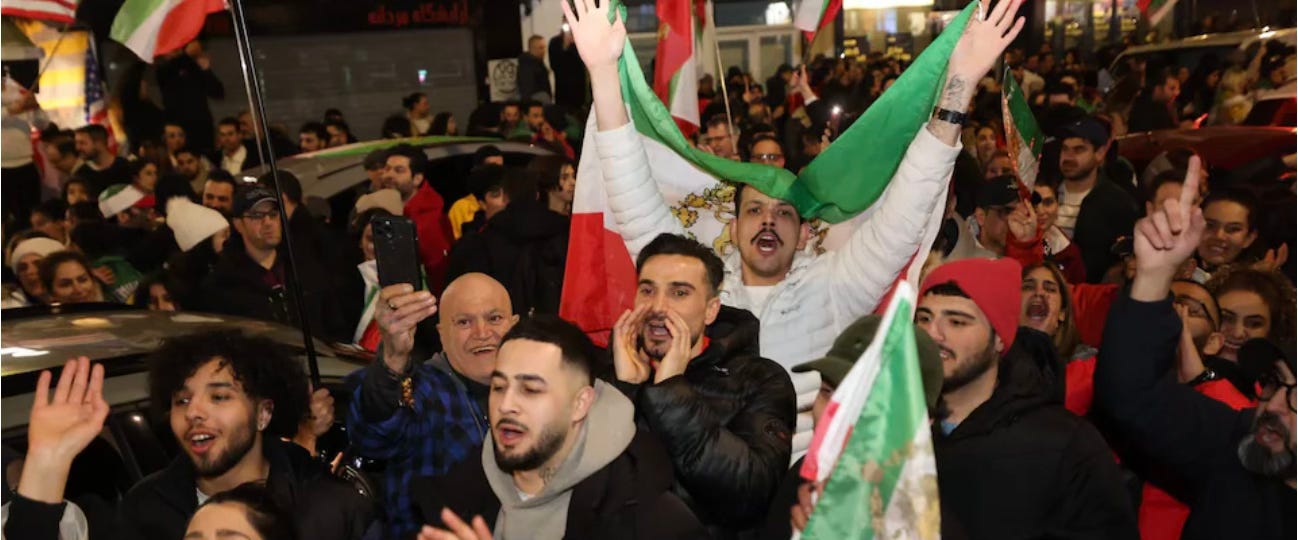
Ignore the Western voices and listen to the Iranian people themselves. After living for two generations under a regime more violent and brutal than any this century, they are speaking clearly enough. Iranians around the world, and inside Iran itself, are celebrating the death of Ali Khamenei. Recordings from Tehran show people pouring into the streets. These are not orchestrated displays. They are the spontaneous relief of a nation that has endured decades of murder, oppression, and corruption at the hands of a theocratic tyranny.
The scale of Khamenei’s brutality deserves to be stated plainly. In recent months alone, his security forces may have killed between thirty and fifty thousand young Iranians. Women were murdered for refusing the veil. Gay men and women were persecuted and killed. And alongside the violence, enormous corruption left ordinary Iranians unable to obtain the most basic medicines: aspirins, blood thinners, the things we take entirely for granted. People have been dying in misery while the regime hoarded the nation’s wealth.
This was not merely an Iranian tragedy. Khamenei’s Islamic Revolutionary Guard Corps tried to kill British soldiers in Afghanistan and Iraq. They sent agents to London to murder journalists at Iran International. Khamenei supported the fatwa against Salman Rushdie that resulted in one of Britain’s greatest living novelists being blinded in one eye. Through the IRGC and its proxies, his regime murdered tens of thousands of Lebanese and Syrians, slaughtering Sunni Muslims across the Middle East for decades. I will not mourn this man, and nor should anyone who values human life and human liberty.
The strategic picture is shifting rapidly. Maduro has gone in Venezuela. Assad has gone in Syria. Khamenei has gone in Iran. Putin is watching and what he sees should concern him. Russia has lost its supplier of the Shahed-136 drones, manufactured in Iran and fired at Ukrainian cities and civilian infrastructure. Yes, there are risks. Higher energy prices could temporarily benefit Moscow. A successor in Tehran could prove more hardline. Iran could attempt to close the Straits of Hormuz. The picture is uncertain, and it would be dishonest to pretend otherwise. But the broader trajectory is unmistakable: the network of authoritarian client states that has sustained Russian and Iranian power projection is fracturing.
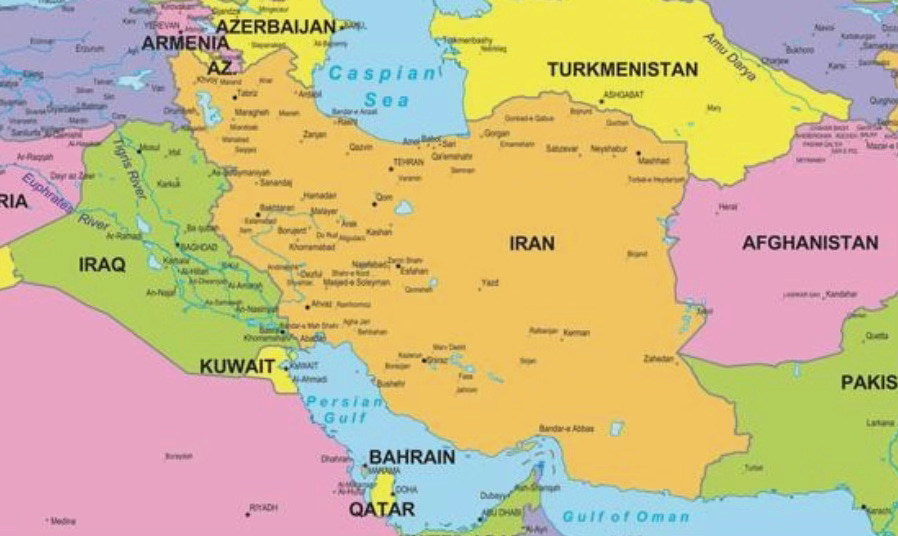
The real question for us is not whether Khamenei’s death is welcome, the Iranian people are answering that. It is what Britain intends to do about what comes next. We have allies and citizens in the region. Rockets are falling on the UAE, a country that has welcomed people of every faith and background, including many British citizens who have built their lives there.
There is a clear and obvious distinction between participating in strikes against Iran and deploying a Type 45 destroyer to the waters around the United Arab Emirates to defend against ballistic missiles. I cannot think of a single credible argument against protecting people from incoming rockets. The Royal Navy exists precisely for moments like this.
Equally pressing is the need to keep the Straits of Hormuz open. Approximately a third of the gas that keeps the lights on in the United Kingdom comes from Qatar, transiting those waters to Milford Haven. There is a ship roughly every three or four hundred miles in that passage. Keeping that flow moving is not a matter of foreign adventurism. It is a matter of keeping the British economy running and British homes heated.
Any Prime Minister worth their salt should be ordering the Royal Navy into the Gulf: to provide anti-missile defence for our allies, to protect British citizens, and to ensure the energy supplies on which this country depends continue to flow. The Iranian people are speaking. The strategic landscape is transforming. Britain must not stand idle while the world changes around it.
Instead we have a leadership paralysed by indecision, unwilling to declare the war illegal and oppose it or to support our allies in countering the biggest threat to our economic security, and the security of our allies in the Middle East in a generation.
We’re doing worse than nothing. Britain is stating clearly that is has nothing: no leadership, no strength and, if this continues, no friends.
Only one flaw with your Type45 plan: The T45s aren’t BMD capable (yet), excellent bit of kit against Cruise Missiles and Anti-Ship missiles but not ballistics. They would however make a valuable contribution to maintaining the Air Picture and controlling Defensive Counter Air missions by fighters overhead, and could be used to engage drones but realistically there are better assets in the arsenal for that.
We had a fleet of anti-mine ships in the Gulf until a few years ago. Along with a lot of defence budgets, they came to the end of their operational lives and were scrapped. Where are their replacements? Along with a lot of other defence options they were not replaced. The minimum defence budget barely funded 100,000 soldiers, sailors and airmen. A sorry end to 14 years of Tory rule.