


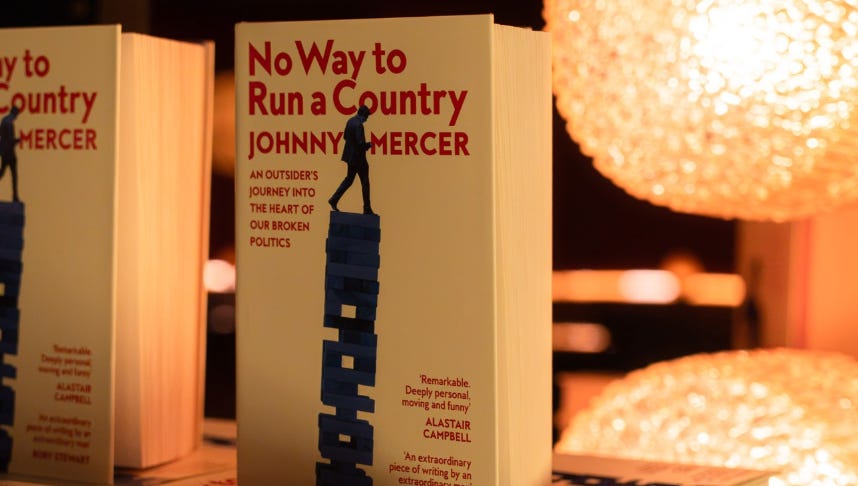
Political memoirs come in three kinds: the boring self-justification of the historian, the raconteur’s reinvention petty score-settling, and then the rarest, the only one actually worth reading, the confessional.
I’ve only read a few who hit the mark. Alan Clark, of course, who’s raw honesty brought his political life alive, Chris Mullin, who swapped the bon viveur’s adventures for the melancholia of thwarted ambition, and now Johnny Mercer. Unlike the other two, he’s neither up nor down, he’s just straight. This story he tells is without any filter or sense of self-protection. It’s better for it.
But don’t listen to me, I’m biased. Johnny and I have been friends since we met in Kandahar nearly 20 years ago when we didn’t have quite so much to say and still less to confess. He’s also been nicer about me than I deserve and this is nothing to do with me.
This isn’t Johnny’s first book so I’ll skip over the bits on the Army, the tours of Afghanistan and the first steps. Though no pages are wasted this is really about his time in politics and that’s compelling enough. It takes us from knocking on every door in his bit of Plymouth, to serving in cabinet and taking the same job for the third time.
What lifts this above the usual Westminster waffle is the voice. Johnny writes as he talks, like a soldier who has read a bit but hasn’t forgotten his crayons. The writing is raw and sometimes painful but the humour is unceasing as he sees the funny side in most situations, mostly by mocking himself.
A pensioner whose shopping he carries tells him he looks fatter in real life than on the telly. He gets lathered in shower gel to pay the bills and ends up on a poster in the Super Bowl. He caves ‘like a KitKat’ when the Today programme rings. David Cameron trying to hold the party together was ‘like trying to knit fog’. A woman from the candidates’ department becomes, for the rest of the book, ‘Mrs Happy’. And one chapter opens by promising a Cabinet post, a sacking, a reinstatement 49 days later, a friendship with a convicted killer and a menthol cigarette smuggled into a prison by a route I will gloss over but he does not.
For all his readiness to be the target of his own jokes, they deliver the most honest account of mental illness by a British politician I’ve ever read.
He was raised in what he calls, with no hesitation, a cult and since childhood Johnny has lived with obsessive compulsive disorder, not the tidy fridge kind I’d imagined but the kind that convinced a kid at boarding school that a dripping tap would bring the building down on everyone inside, and later banging his head on a sink would make the thoughts stop. A psychiatrist told him people like him did not hold down normal jobs.
He found order in the Army but not a cure. Afghanistan helped. You’re not paranoid when everyone really is trying to kill you. The obsessions have to wait. Westminster gave time for demons. Nights in hotel rooms and hours waiting for the division bell made life worse and only running exhausted him to sleep. Through this Alastair Campbell turns out to be one of the heroes.
Johnny makes clear what it cost to write this book but he did it anyway because he knows what it meant to hear others’ stories. ‘The overwhelming emotion that has dominated my life has been one of an intense and almost permanent loneliness. You don’t need to feel that.’ That’s courage.
He’s interesting about that. ‘Courage in war has been described in many ways. I found it to be like a bank account - you can withdraw from it, but it is very difficult to top it up.’ He’s right. The dread before patrols he describes as wanting to vomit. And over time, the courage runs out. He describes cradling a dying soldier in the dark as the man grew heavier and colder. He dresses none of it up.
It’s clear that from his maiden speech to the last day in Cabinet, Johnny has known what he’s in politics for and this book draws it out in colours so bright it can only be true. He’s been focussed on the welfare of those we served with, the veterans and the families who went through those wars and the scars they left.
That explains the political fights. Taking on the Iraq Historic Allegations Team meant taking on his own government within months of arriving and getting pathetic threats and weasel games from people who have no place in our politics.
The book loses focus on Brexit, but frankly, who didn’t? Those Groundhog years were painful for everyone. And Johnny’s anger sometimes gets the better of him as he admits, but doesn’t always examine, but these faults show how little editing he, or anyone else, did to this book.
It’s worth reading. After seven prime ministers in 10 years, he’s right, this is no way to run a country. Johnny’s diagnosis is moral not really political and he sees correctly that Westminster does something to people, it trades character for convenience, as we accommodate compromises slice by slice. His answer is better people, and again he’s right. Because, dear reader, you get the politicians you choose. Either by voting them in or by not choosing better candidates or failing to stand yourself. Johnny shows the price decent folk pay for entering politics, and his book shows the price our country pays for so many refusing to serve.
That makes his closing plea tough on those who only read about politics. If a man who never voted, who grew up in a cult, who’s still nuts in his own way, can get into the Cabinet and change the lives of thousands of veterans on the way, then the club isn’t as closed as many pretend. Democracy works, but only if you take part. He did, this is his story. What’s yours?
I have followed Johnny for a long time, and consider him to be very honest. I dont agree with all his thoughts but he went to parliament as a patriot and did many great things. I will look forward to reading his book. Look at a photo of slumbering slobs on the Benches. Hes right. This is no way to run our country
The 14 years of Tory rule were a lesson to us all, especially those of us on the left of politics. Did Rees-Mogg and the ERG blackmail Cameron into agreeing to a EU referendum? Why on earth were the LibDems blamed for all the austerity between 2010-15? Did none of the Tory voters notice the effects of austerity which took 174,000 lives according to the Rowntree Trust. When the economy started to falter after June 2016 and the vote for Brexit, where were the MPs on Treasury committees who must have noticed and should have demanded that the 36% who had voted Leave be ignored? I remember Johnie in his various Cabinet positions and his obvious difficulties with party policies.