


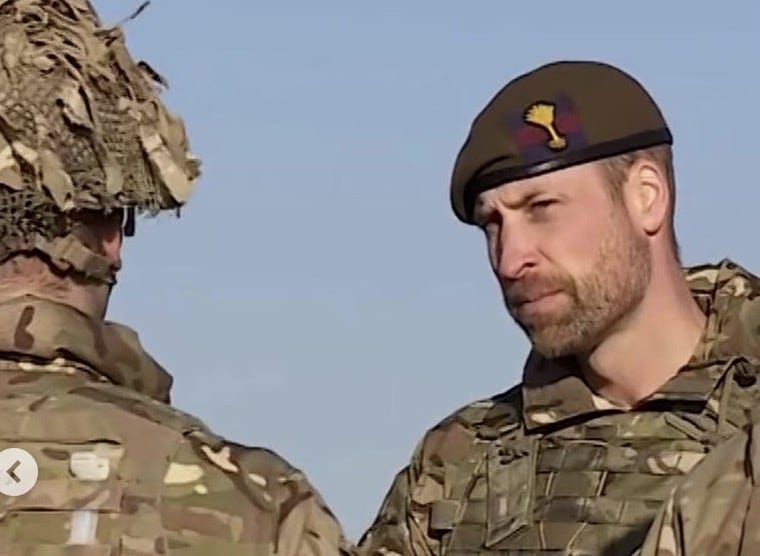
The SAS charity looks after those who have given everything to keep us safe. Those who have stood on the rough wall and defended our freedom and have stared into the heart of darkness and come back changed. Some have made mistakes, some are heroes, all have made choices on our behalf in conditions when most of us would be frozen by fear.
By accepting to become patron even after the accusations of abuse in recent years, the Prince of Wales is stating clearly not that he is excusing or ignoring any crimes but that he has the political maturity and honesty to see the compromise people make in conflict and stand with those who serve. That leadership is sadly lacking in Westminster with Labour’s legalism.
There are no excuses for crimes but Prince William is resisting the temptation to pretend that war can be rendered clean, bloodless, or morally effortless through legal abstraction; and rejecting the false binary that those who fight on the nation’s behalf must be either saints or villains, with no space for human reality in between.
With both the Chief of the Defence Staff and head of the Secret Intelligence Service warning us that Russia is bringing us closer to conflict, this is no time for the luxury beliefs that have infected our politics for a generation. The SAS is key to our counter terrorist defence and discreet operations in support of our allies around the world.
War is willed in the abstract but disowned in the concrete
Soldiers are not saints. They are human beings placed in conditions of extreme danger, fear, exhaustion, and moral pressure. They operate in environments defined by uncertainty, speed, and irreversible consequence; but they are also men and women who risk everything for the safety of the nation. Any ethical framework that cannot hold these two truths together is inadequate to the task it claims to perform.
The growing civilian legal intervention in war represents a fundamental category error. Armed conflict is not a form of peacetime governance, subject to the assumptions and expectations of civilian legal regimes.
Those preaching the shift towards normalising courts in conflict often presented this as moral progress. In reality, it reflects a refusal to accept the distinctive nature of war itself. Combat is not policing by other means. It is an exceptional condition in which control is partial, information is fragmentary, and decisions must be made under severe time pressure with consequences that cannot be undone.
The Law of Armed Conflict exists precisely to address this reality. Better known as the Geneva Conventions, it recognises necessity, proportionality, distinction, and command responsibility within a context of chaos rather than certainty.
As I argued more than a decade ago in the Policy Exchange papers Fog of Law and Clearing the Fog of Law, its strength lies in its acceptance of imperfection. It does not demand error-free outcomes. It demands judgment exercised in good faith under conditions of risk. That is the moral and legal foundation on which disciplined armed forces are built.
The Geneva Conventions do not excuse crimes either. The concept of war crimes was most clearly demonstrated in the Nuremberg Trials just after the Second World War using a concept dating to 1474 when Peter von Hagenbach was executed for the atrocities he committed during the occupation of Breisach.
By contrast, those who impose the European Convention on Human Rights into active combat operations import peacetime legal expectations into an arena where they cannot sensibly operate. Rather than clarifying responsibility, it reverses it. Decisions authorised at the political and strategic level are retrospectively judged at the tactical.
For it’s Tommy this, an’ Tommy that, an’ Chuck him out, the brute!”
But it’s “Saviour of ‘is country” when the guns begin to shoot;
Responsibility is pushed downwards onto junior soldiers, enabling those who will the ends to distance themselves from the means by which those ends are achieved. War is willed in the abstract but disowned in the concrete. Those closest to the point of action carry the burden of blame, while those who set objectives, constraints, and rules of engagement retain moral distance.
The result is not higher ethical standards, but an ethics of delegation without responsibility. What is presented as accountability is in reality a mechanism for moral displacement. It is the legal expression of Kipling’s poem: “Tommy this, an’ Tommy that”.
This has consequences beyond individual cases. A state that authorises force while denying ownership of its inevitable costs engages in moral bad faith. It criminalises service and leaves the weak vulnerable by imposing restrictions on the strong who would defend them.
The strategic implications are severe. When those trained and authorised to use force are constrained by inappropriate legal fear, power does not disappear. It migrates. Adversaries unconstrained by such norms are empowered and exploit hesitation and delay. We have effectively neutered ourselves, ceding moral and physical ground to those willing to use violence without restraint or accountability.
This dynamic reshapes behaviour on the ground. Commanders are made cautious when boldness is required not only to win but to save lives. They become risk managers rather than leaders. Soldiers learn that hesitation is punished and safer than action, not because it saves lives in battle, or wins wars, no one is responsible for that, but because it reduces exposure to future legal jeopardy. This does not make war more humane. It makes it more dangerous, more prolonged, and more corrosive to moral agency. Lives are lost not through excess, but through paralysis.
Standing with the SAS Association in this context is not a denial of law, nor a claim that soldiers should be beyond scrutiny. It is a rejection of scapegoating and a defence of the proper application of the right law. Where credible evidence exists of criminal conduct under the Law of Armed Conflict, investigation and prosecution are necessary. But accountability must be rooted in a legal framework that understands war as war, and a moral framework that assigns responsibility to those who authorise it.
First published in the Daily Telegraph here, 24 December 2025.