


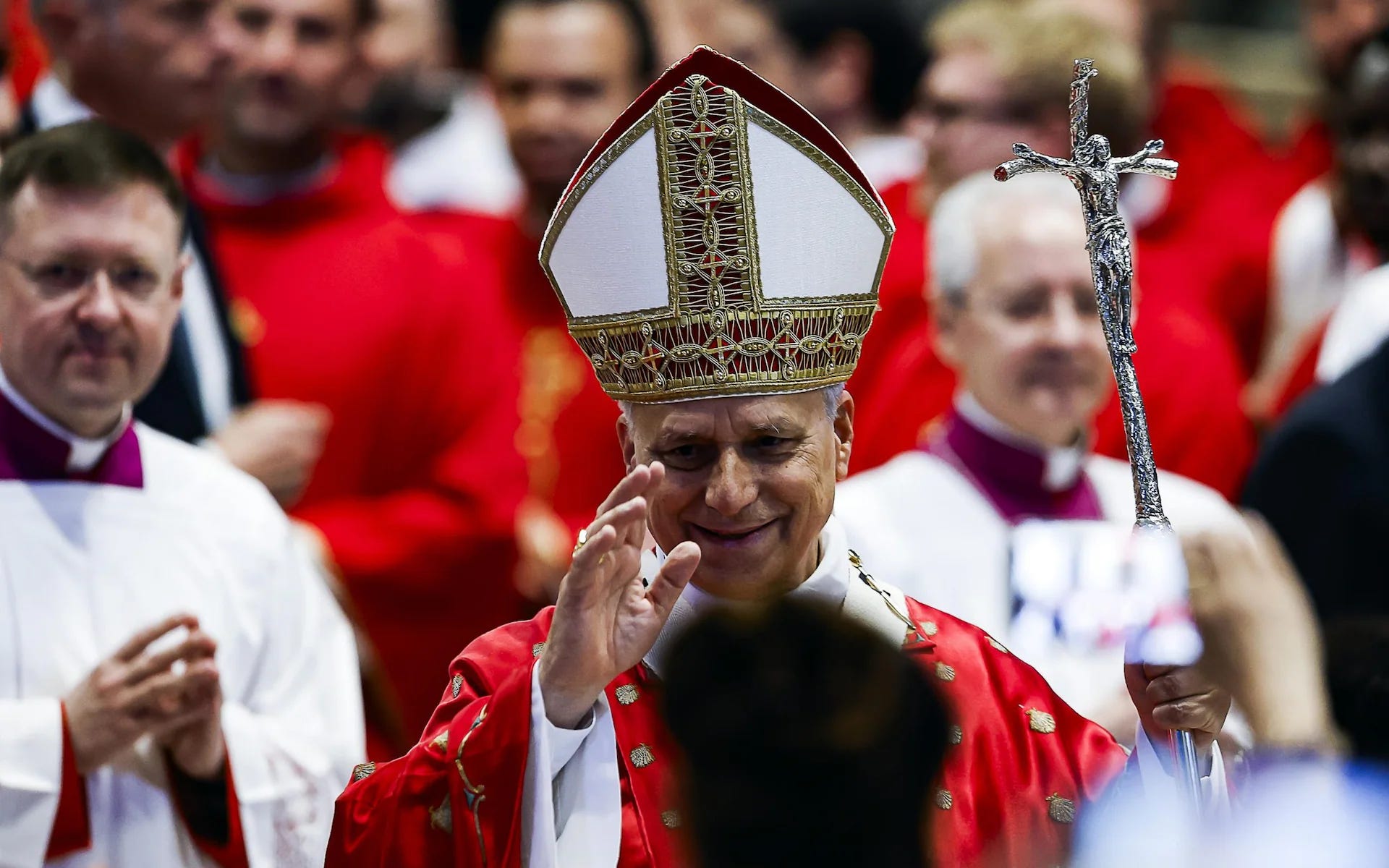
Pope Leo XIV’s first encyclical, Magnifica Humanitas, repeats the lesson of the incarnation of Christ, that man stands at the centre of the work of the Divine, and renews the challenge for our own day.
The Holy Father is clear that artificial intelligence now risks this elemental Christian theology threatening human dignity by turning the ownership of our data into a new form of slavery, just as cruelly as that ubiquitous sin did, and does, around the world.
The Pontiff says that, because of this harm, artificial intelligence cannot be governed by good intentions alone, still less by the consciences of the engineers who build it. He calls again and again for law: robust legal frameworks rather than ethics invoked in the abstract, independent oversight rather than the promises of the new pharaohs of Silicon Valley, and a human being who can be held to account when a machine decides who receives a loan, a job, a hospital bed or a place at a school. It is a bold challenge to parliaments the world over. But is it possible?
The Bishop of Rome wants the new electronic Curia regulated rather than quietly surrendered to a few private companies whose reach already exceeds that of most governments. He even commends, here and there, the courage to slow down. As a Catholic, I say amen to all of it. As a parliamentarian, I have to confess that the hardest part is not the principle. It is the clock.
The machine and the statute do not keep the same time. Artificial intelligence is built at the speed of the start-up, where the instinct is to move fast and break things, to ship first and patch later, to run a beta test on the rest of us and call it progress. The updates that transform it are not set only by the market or by the contest between Claude and ChatGPT; they are driven by the pace of mathematical innovation, in Shenzhen and in a thousand laboratories besides.
There is a deeper reason than speed, and it is one every legislator should learn early. You cannot pass a law against mathematics. Parliament can govern what a person does, never what a person knows; it can forbid an act, but not a theorem, a discovery or an idea. A statute may regulate how a model is used, who answers for its decisions and what may be done with its results, yet the equations that make it possible will go on being written whether we consent to them or not. Law reaches actions, not ideas, and innovation is an idea long before it is ever an action.
Parliaments cannot keep up. Law, in democracies at least, moves at the speed of consent, which is to say, slowly. The lag is not a failure of management that some brisk minister might close over a weekend. It is deliberate. A democracy rests on the consent of citizens, not the custom of consumers. Move fast and break things works in startups. It costs lives in countries. When a company fails, another is born, but when that happens to a state we call it revolution, and the chaos costs lives.
This is not the first time we have struggled to keep pace with innovation or with the changes it forces on our lives and our society. The printing press reached England in 1476, and it took the better part of 250 years before Parliament passed the Statute of Anne and gave copyright its first modern form. The telegraph transformed trade and remade empires long before any treaty governed the cables beneath the sea.
Closer to home, the European Union spent years grinding out its Artificial Intelligence Act, and our own Parliament spent the best part of five years on the Online Safety Act, by which time the harms it was drafted to meet had bred new ones, and a generation of children had grown up inside them. We have always been behind the innovation curve. We will be again.
Anyone who has nodded through a committee session knows why. Legislators must weigh the risks and not only the opportunities. They must hear the engineer and the ethicist, the company and the customer, the union and the investor, the bishop and the unbeliever, the mother afraid for her child and the founder afraid for his firm. Cut that listening short and you are left not with a settled law but a stalled one, as the bitter passage of the assisted suicide bill has shown.
A democracy is not merely a tyranny of parliamentary arithmetic; it must take evidence, publish drafts, suffer amendment, survive challenge and emerge with something that commands enough assent to be obeyed without constant compulsion. That is not dithering. It is the difference between a law and a decree.
A democracy is slow because it governs by cooperation; a tyranny is quick because it governs by command. Speed may appear to give answers, but it opens fractures, and it remains brittle. Authoritarian states legislate on artificial intelligence at a pace no Western cabinet could match, yet a regime that cannot admit what happened in Tiananmen Square in June 1989 cannot teach its machines the truth about its own past, and so forces deceit into its models.
Rule by fear corrupts its own knowledge at the source, with consequences that fall on everyone, as the Covid crisis showed the world. Our system, for all its exasperating slowness, rules by argument and agreement, which, when we are honest enough to conduct it, gives the more enduring answer.
And yet the Bishop of Rome, spiritual guide and temporal prince upon the throne of St Peter, shares the frustration of many that our inaction can look like complacency. It is not. Every few months OpenAI and Anthropic release versions that remake what a computer can do, and there is no way a legislature can keep step. Even if every MP and every congressman grasped the finer points of large language models and stochastic parrots, they could not win consent for the changes, nor reconcile the benefits that pull against one another, fast enough to matter. And our rivals, in China above all, would feel bound by none of the same constraints.
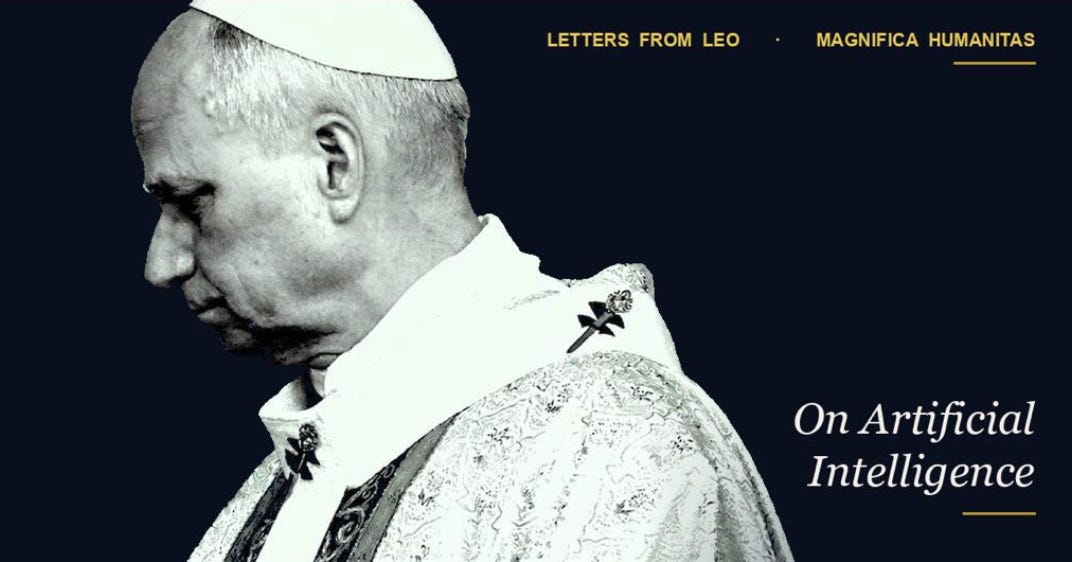
So the slowness is not merely a weakness to be apologised for. It is the discipline of free people. St John Henry Newman, whom this very Pope proclaimed a Doctor of the Church only last November, saw it when he wrote that to live is to change and to be perfect is to have changed often, and that the institutions which last are precisely those that can change while remaining themselves. The genius of parliamentary government is that it lets a nation alter its laws without losing its soul, carried by institutions that remember why an earlier generation chose as it did.
So what should guide us, if not the law alone? It is not enough to say that the law is too slow, for that leaves the field open to a cavalier handling of the most consequential inventions of our age. Nor can the task be surrendered to the princes of technology, whom the Pope names without flattery, those who raise cathedrals to their own ambition and ask no one’s leave. The temptation to build Babel is not confined to our rivals. It is alive in our own boardrooms and our own vanities.
The Holy Father sets against that tower the figure of Nehemiah, who rebuilt the walls of Jerusalem not by command but by summoning the families and giving each its length of wall to raise. That is the truer image of what we must now do, and it was not legislation but inspiration. What raised those walls was not a statute but a shared conviction, a people persuaded that the work was theirs and that it answered to something higher than their own interest.
Who can summon such builders today? Perhaps that is the real answer Magnifica Humanitas gives. It is Rome. Which other spiritual leader can corral presidents and princes, tyrants and technologists, and make them weigh the questions we all face? Legislators cannot. If the Pope is looking for a new Nehemiah, perhaps he should start with himself.
First published in The Telegraph 27 May 2026
Tom,
Interesting essay, but I wonder if implementing the Pope’s ideas is actually far simpler than you think?
The Pope's principles don't require Parliament to outrun the algorithm. They require company law to catch up with company behaviour - a race is far more practical and winnable.
We already know how to make named individuals accountable for systemic failures within organisations. The Senior Managers and Certification Regimes do exactly this in financial services. A named director personally liable for the ethical conduct of their company's AI systems is neither utopian, nor a legislative fantasy. It is mapping an extension of existing instruments onto a new domain. And Parliamentarians are quite good at that!
The real bottleneck isn't legislative speed. It's the habit of treating AI as a product problem rather than a governance problem. By regulating the boardroom and not the algorithm you fix most of the problems out outline. The Pope's call for robust human accountability and making a human being answerable when a machine decides who gets a loan, a job, or a hospital bed becomes entirely achievable. All without waiting for Parliaments around the world to understand how cutting-edge AI architectures work or where the bleeding edge of start-ups and LLMs are headed.
Nehemiah didn't need new tools. He needed people who knew which wall was theirs to build and to hold them accountable for it.