


In May 2004, at a checkpoint in southern Iraq, the British had named Danny Boy, an ambushed British patrol fought the Mahdi Army hand-to-hand for three hours. Twenty-eight insurgents were killed. No British soldier died, and five were awarded the Military Cross.
What came next did not happen on the battlefield but in Birmingham. Phil Shiner of Public Interest Lawyers paid fixers in Maysan to find Iraqis willing to accuse British soldiers for money. By 2008, he was holding press conferences claiming British soldiers had captured 20 Iraqis alive at Danny Boy, taken them to Camp Abu Naji, and executed them.
The claims were extraordinary. If true, there would have had to have been a conspiracy among the British troops at the base, reaching from the commanding officer and the padre to the most junior soldier. Still, the Al-Sweady Inquiry sat for 169 days and cost the taxpayer £31m before Sir Thayne Forbes found every serious allegation to be the product of deliberate lies, reckless speculation and ingrained hostility.
Shiner’s firm had by then been the source of around 65 per cent of the Iraq Historic Allegations Team’s 3,392 cases. IHAT cost the taxpayer some £60m and was disbanded in 2017 without a single prosecution. Shiner himself was struck off, bankrupted, and in December 2024 sentenced on three counts of fraud. But he had also defrauded the British people by accusing the soldiers who had defended them.
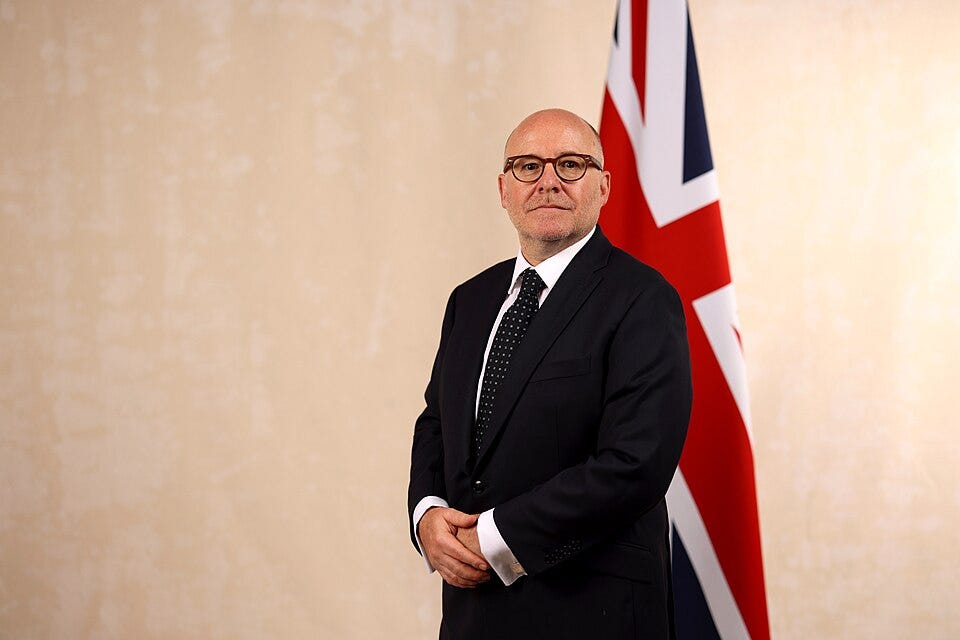
This week, The Telegraph published its investigation, having scoured 25,000 pages of papers from the Al-Sweady case. It showed that the lead counsel for eight of Shiner’s Iraqi claimants was Richard Hermer, now Lord Hermer, the Attorney General of the United Kingdom, He took the brief not under the cab rank rule, but on a conditional fee arrangement with a success uplift: he deliberately chose to do this work.
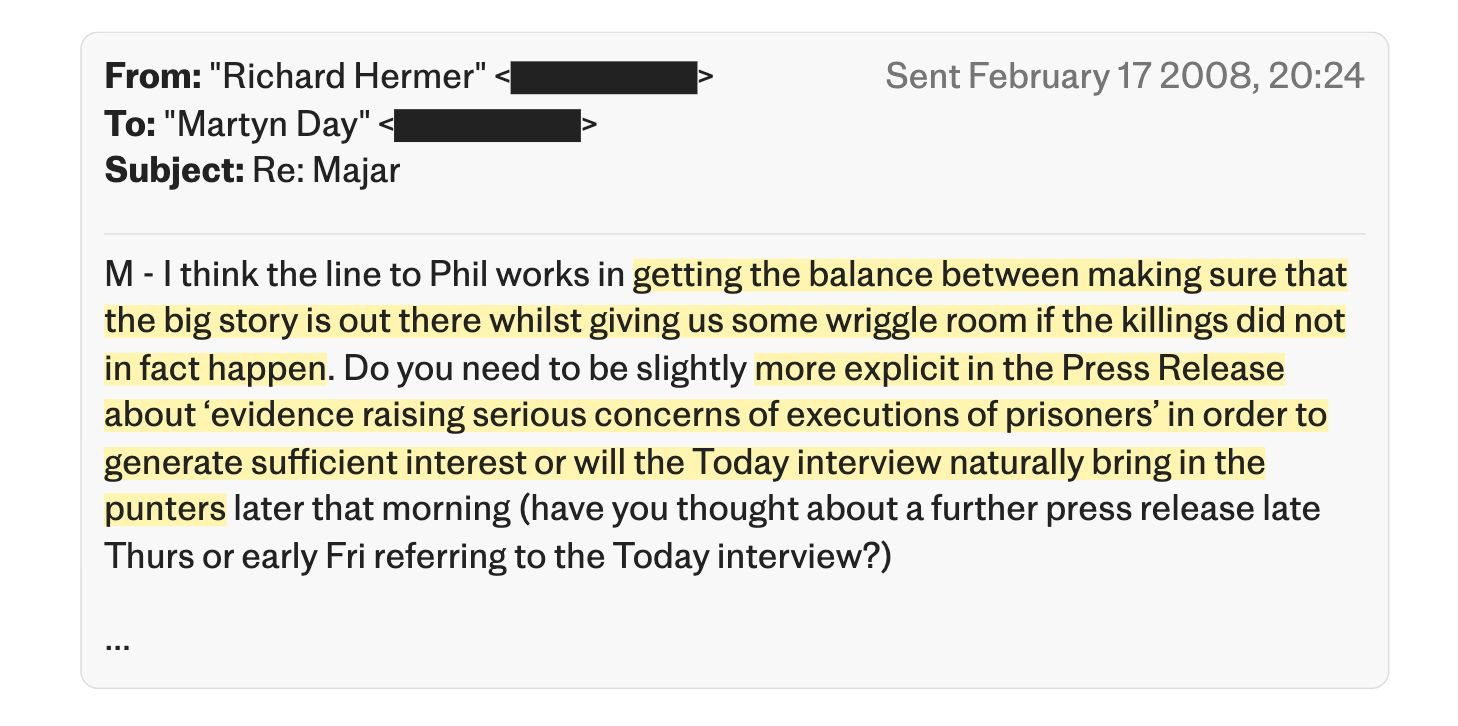
What’s more extraordinary is that he chose to continue even after he suspected the claims might not be credible. In 2008, Hermer advised Leigh Day on a draft press release. His own suggestion, which we have in writing, was that a particular wording would “give us some wriggle room if the killings did not in fact happen”, and that the release needed to be “slightly more explicit” about “executions of prisoners” to “generate sufficient interest”. Shiner replied: “I think R is right, so let’s up the ante.” A line alleging torture and execution of witnesses was duly added.
Those allegations weren’t just lies: they put British troops at risk. Those words were recruiting sergeants for those who saw our troops not as friends trying to protect Iraqis from Iranian-backed militias, but enemies come to murder their sons. How many soldiers died as a result of what was said at that press conference? We will never know.
Five years later, as the case collapsed around him, Hermer didn’t back down. Instead of encouraging the claimants to go quietly, he was advising that they seek settlements of between £45,000 and £55,000 per claimant. Not to vindicate his clients, whom his correspondence with his solicitors shows they doubted, but to conclude settlements before Sir Thayne Forbes gave what was ultimately his damning judgment. That is not service to the country.
The Prime Minister himself worked the same seam, pro bono, for interveners including Amnesty International and Liberty. Out of choice, not obligation, Starmer and Hermer brought to bear the full weight of the British human rights industry against the junior soldiers their own leaders had already shamefully abandoned.
I wrote about this betrayal as the first thing I did on leaving the Army, in The Fog of Law with Laura Croft for Policy Exchange in October 2013, and in Clearing the Fog of Law with Richard Ekins and Jonathan Morgan two years later. I could already see what was coming.
The operational consequences are no longer speculative. Lieutenant General Sir Paul Newton observed a decade ago that commanders at every rank were registering creeping risk aversion, pre-empting the inquiry they knew would follow any decisive action. The question had shifted from what the enemy would do to what the judges would say. That is not a framework in which wars are won, the weak protected, or lives saved. It is one in which they are slowly, expensively, lost.
Hermerism today is the defining creed of our Government. It is the clerical dogma that democracy is subservient to an eternal law interpreted by a cult that puts the security of the British people under the most expansive reading of human rights law. It is the luxury belief only possible among those who have no understanding of true danger and the cost of war. It leaves us weak, unable to protect ourselves, and empowers those who are willing to use force and ignore the pompous piety of the legal priests.
Not content with emasculating our forces, Hermerism is also neutering our foreign policy. In a Lords debate last April, pressed by Lords Verdirame and Godson, Foreign Office minister Baroness Chapman defended her Government’s “regret” at Lithuania’s withdrawal from the Convention on Cluster Munitions and at Poland and the Baltic states’ withdrawal from the Ottawa landmines treaty. Frontier democracies preparing for a Russian army that has raped and murdered innocents were being reproached by a British minister for defending their own soil.
It’s no surprise that in Washington, British soldiers – who once stood as America’s most trusted wingmen – are now seen as little different from the Dutch peacekeepers who cited their rules of engagement and stood by as the men and boys of Srebrenica were marched away to be murdered in 1995.
The hypocrisy is complete. These lawyers claim courage as they pursue 80-year-old paratroopers for decades-old allegations long since disproved, then fall silent when the Uyghur community in Xinjiang asks for protection from China, or the villagers of Darfur for protection from the Janjaweed. If courage costs nothing and pays well, perhaps it has another name.
People are busy. They do not follow every disclosure or tribunal ruling, every email released five years too late, and every allegation, but they know recruitment is down, and those they respect are walking away from uniformed service. We all know something is wrong.
When I first wrote about this poison, I could see its effect on the young men and women who were risking everything in battle. Their lives, in the heat and confusion of combat, weighed less than the views of lawyers in the cool and order of a courtroom. Now the poison, like Wormtongue at Théoden’s ear, sits at the heart of Government.
British people value rights and will fight to defend them. We welcomed Ukrainians whose lives were at risk and offered sanctuary to Afghans who fought alongside us. It is not justice the public recoils from, it’s the con: the rights of the nation’s enemies placed above the safety of its children, and the lawyers who claim to defend the weak profiting from legal tricks against those who stand between us and the devil.
These revelations must mark the end. Parliament should derogate from the European Convention on Human Rights (ECHR) in deployed operations, as Article 15 expressly permits. It must legislate a clean doctrine of combat immunity, and restore the primacy of the Geneva Conventions, not of civilian courts. And Parliament should not repeal the Northern Ireland Legacy Act. It should keep it, strengthen it, and apologise to the octogenarians it was written to protect.
Lance Corporal Brian Wood of the Princess of Wales’ Royal Regiment, awarded the Military Cross for Danny Boy and then falsely accused by Lord Hermer’s clients of executing prisoners, has called this week for the Attorney General’s resignation. He did not fight his heroic battle so that the lawyers who called him a murderer could run the country that sent him.
It wasn’t just soldiers who were used. Iraqi families who wanted nothing to do with the militias were exploited, their grief hired out, their dead made into props in a litigation business.
The industry that committed these legal atrocities calls itself the defender of human rights, and its most accomplished practitioner is the Attorney General of the United Kingdom. It is nothing of the kind. It is the slow, deliberate crippling of the only hand that, when the screaming starts, has ever reliably been raised to stop it.
Thank you, Tom, for your principles and clarity. We know these calumnies against our troops in both the US and Australia. I wish we knew the way forward from this abyss.
Why is this not in the greater public domain! Why would any sane person volunteer to defend a country that does not defend them! This makes my blood boil 😡
Please , please keep getting the message out there- thank you for all you do & write 🙏