


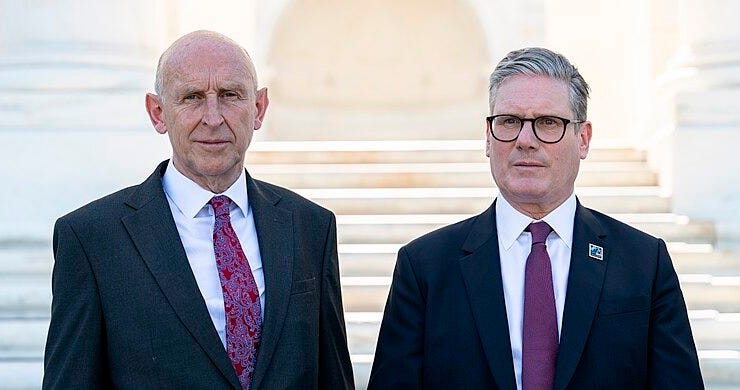
The last minister to resign over national security was Lord Carrington. In 1982, Margaret Thatcher’s foreign secretary took responsibility for the Foreign Office’s failure to anticipate or prevent the Argentine invasion of the Falkland Islands. His integrity gained him the respect of the nation.
Now John Healey has done the same. Across politics, many will recognise the burden of the choice. Healey has been living and breathing defence for years, and his commitment has drawn respect from all parties, including mine. But he knew what needed to be done and that’s exactly why he has gone. Healey can see what is coming and, more importantly, what is not.
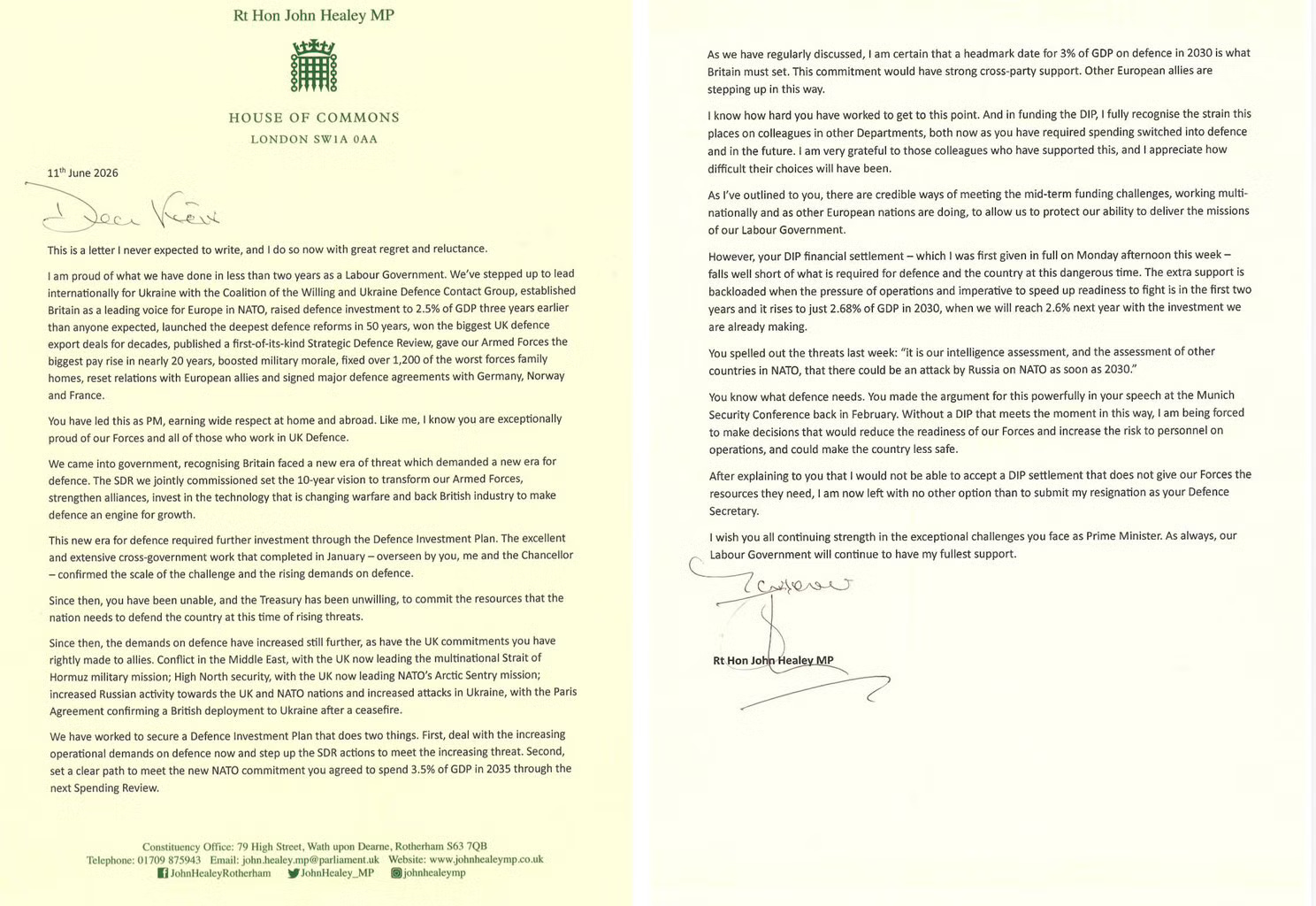
His resignation letter is the most damning document published by a departing minister in decades, even more so because it convicts the Prime Minister out of his own mouth.
“You spelled out the threats last week,” Healey reminds him, “‘it is our intelligence assessment, and the assessment of other countries in Nato, that there could be an attack by Russia on Nato as soon as 2030.’” That doesn’t leave room for complacency or delay.
“You know what defence needs. You made the argument for this powerfully in your speech at the Munich Security Conference back in February.” “You have been unable, and the Treasury has been unwilling, to commit the resources that the nation needs to defend the country at this time of rising threats.”
Those two words – unwilling and unable – are this Government’s obituary. It’s not a minister falling out with his Prime Minister but a minister telling the country that Sir Keir Starmer knows what he should do, but is too weak to do it.
The numbers make it clear. The Defence Investment Plan financial settlement, which Healey “was first given in full on Monday afternoon this week, falls well short of what is required for defence and the country at this dangerous time. The extra support is backloaded when the pressure of operations and imperative to speed up readiness to fight is in the first two years and it rises to just 2.68 per cent of GDP in 2030, when we will reach 2.6 per cent next year with the investment we are already making”.
This is the detail that matters because it collapses every promise made and statement given.
First, it is astonishing that the defence secretary was first shown the funding of his own plan only three days ago, more than a year after the plan was commissioned. Second, the offer appears to be a rise of 0.08 percentage points of GDP over three years, roughly £2bn a year (or two destroyers) in today’s money by the end of the decade.
So, using the Prime Minister’s own intelligence assessment that a Russian attack on Nato could come by 2030, the plan would deliver… almost nothing. And worse, it would only deliver what little it did in the year the attack is expected. Nothing in advance. Nothing to prepare.
As Healey says, the whole point of the plan is readiness in the first two years to deter an attack. So it’s clear: the promises are fake, and the man responsible for keeping them has told us so in the most public way possible.
This isn’t just accounting tricks. As I wrote in this paper only a few weeks ago, Britain holds around eight days of war stocks and is often down to one or two operational frigates or destroyers. The Iran war and Hezbollah’s attack on Cyprus exposed our nakedness and reminded us that conflict isn’t distant. It is already happening in the Mediterranean, the High North, and the North Sea, and much sooner than 2030.
So what does this say about the Government if its first duty is to protect the realm? It says it’s over.
Through weakness and capitulation, Starmer has put welfare ahead of warfare.
And what does it say about the prince in the north? In the week the defence secretary resigned because he couldn’t fund readiness needed to protect us,
Andy Burnham chose to back the WASPI campaign, a pledge costed at £10bn that everyone in Westminster knows will never happen. Burnham is spinning stories while Healey is grounding facts.
Starmer’s choice to lose Healey will cost us even now. We know that Russian ships are surveying our cables and communications infrastructure. If they strike, it won’t just be the cost of repair that matters but the reputation of the state. Britain’s credibility will be the collateral and our borrowing costs will rise and inward investment fall as those who trusted us will question our commitment to protecting them, too.
We’ve all now looked into the soul of the British state and what we see is a void. In a straight fight between the First Lord of the Treasury, as the Prime Minister is properly titled, and the Chancellor, it was the Prime Minister who blinked. It’s not Number 10 in charge but the accountants at Number 11. The chiefs saw it, too. That is presumably why the Chief of the Defence Staff wrote to Starmer this week. We have to assume that the secretary of state walked so the chiefs don’t have to, yet.
So what next? Carrington resigned after Argentina had invaded the Falklands, while Healey resigned before the bill has come due. That is the difference, and it is the only mercy in yesterday’s news. The warning has been given, in writing, by the man who knows best. The question Healey’s letter leaves hanging over Downing Street is the one that Starmer must now answer: if the Prime Minister knows all this, and will not act, what is he for?
First published in the Telegraph 12 June 2026
This disaster has caused the resignation of the wrong person.
For context, defence spending in 2009 was 2.65% . It was down to 2.23% by 2023. Clearly the Conservatives were finding it hard to raise the funds for defence.