



Who is in charge of the clattering train? asked Edwin Milliken, writing in Punch after the fatal crash at Eastleigh in July 1890. His answer was simple. Death was at the controls.
The axles creak and the couplings strain. As the train careered through the night, no one was driving.
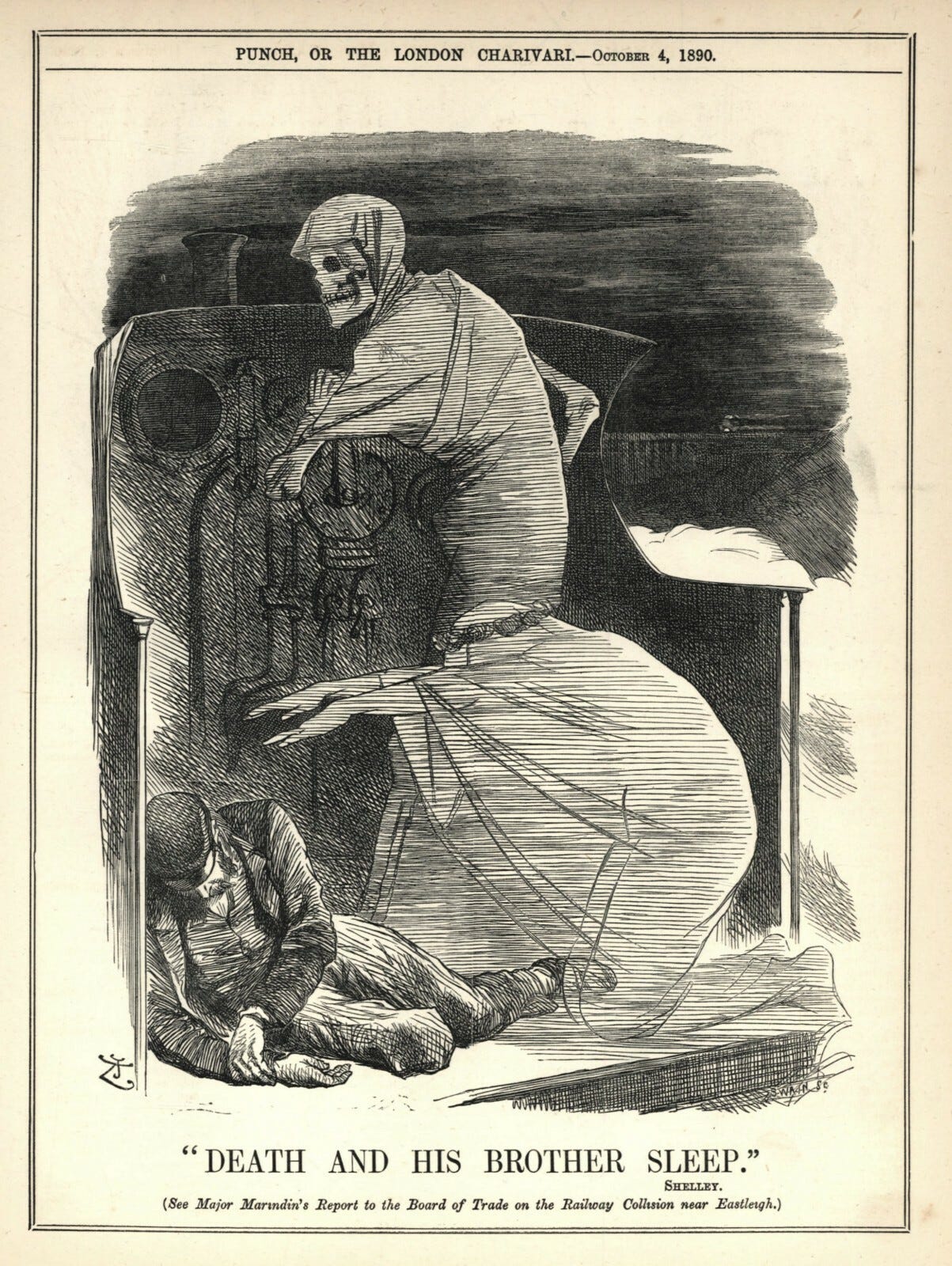
The same question could be asked in Westminster today. The footplate is empty and the driver is missing.
Some are pointing the finger at Sir Oliver Robbins. But where does that lead?
Robbins has left his post as Permanent Under Secretary at the Foreign, Commonwealth and Development Office after it emerged that Peter Mandelson had been appointed Britain’s ambassador to Washington despite failing his developed vetting. The civil servant, it is said, overruled the security professionals and failed to tell the Prime Minister. His political judgment was off, they say, and he must go. And go he has.
But what is the order of things? And what should have happened?
By the time Robbins arrived, we could already say: the pace is hot, and the points are near. Mandelson’s appointment had been announced publicly before Robbins took up his post. That key fact determines everything.
A public announcement of an ambassadorial appointment is not an invitation for discussion. It is a statement of fact, made only after agrément, the formal acceptance of a representative from a foreign state, has been received from the host government.
The announcement, made on 20 December 2024, meant, or should have meant, that the White House had already confirmed it would accept Mandelson as His Majesty’s representative.

That is not a bureaucratic formality but a formal diplomatic exchange between sovereign governments. You do not request agrément before vetting is complete, because to do so is to state, on behalf of the British Government, that the candidate is suitable. It is not an opinion. It is a statement.
Once given, agrément is extraordinarily difficult to rescind without a diplomatic incident.
So what was Robbins supposed to do? He arrived in post in January and read a file that, in all likelihood, said nothing new. The signals had flashed through the night in vain. The cautions in that file had already been communicated to Number 10 by journalists and, as the Prime Minister confirmed in Parliament, the security services before the appointment was announced.
But no one was listening. Sleep had deadened the driver’s ear. The Prime Minister had been told of the concerns, understood the reputational risk, and proceeded anyway. He judged Mandelson’s commercial and political usefulness in managing the early Trump relationship outweighed the warnings. Or perhaps he just owed Morgan McSweeney a favour. That is a political judgment, and it is, in the end, the Prime Minister’s to make.
Which brings us to the constitutional question. If Robbins had walked into the Foreign Secretary’s office with the file and said the appointment could not proceed, what exactly would he have been doing? He would have been a civil servant vetoing a political decision taken by an elected Prime Minister who had been informed of the relevant facts. That is not his role.
Civil servants advise, ministers decide. The moment a Permanent Secretary substitutes his judgment for that of an elected government on a matter that government has already considered and determined, he is undermining British democracy. That is far more serious than any failure of process.
There is a second question. Why, having identified the vetting failure, should Robbins have escalated it? To what end? The decision was taken. The agrément had been given and publicly announced. Broadcasting the concern at that stage would not have protected national security. The appointment was already in train and the envoy already on his way to Washington. Robbins’s principle would have been vanity. He would have achieved nothing but the undermining of a British ambassador, depriving him of the authority he needed to do the job the Prime Minister had sent him to do. That is not governance. It is petulance, and it damages the nation.
The real sequence of events is now coming into focus, and it is rather different from the narrative Number 10 has offered. The Prime Minister made a political judgment about a twice-disgraced candidate whose vulnerabilities we all knew. He assured the White House the candidate was suitable by seeking agrément before he could have been confident that what he was instructing the King to say was true. Vetting was not complete, or at least the failed result had not formally communicated to him. Then he announced the appointment publicly before the process was concluded.
In short, the Prime Minister is not right when he says that “process was followed.” It was not. Against the advise of the then-Cabinet Secretary, Sir Simon, now Lord Case, Starmer announced before the vetting had been completed.
By overriding the Foreign Office advice politically, and announcing publicly a result while the process was ongoing, he removed the brakes from the clattering train and silenced the signals. He stripped officials of any practical ability to act on an adverse finding and ensured one outcome.
That is not a failure of process by the Permanent Under Secretary. It is an evasion of process by the Prime Minister himself.
As the red-tape-tied lawyer always explains when he doesn’t know what to do and gets himself into a tight spot, process must be followed. In this case the sequence is long established: internal selection (always conditional and subject to vetting), then vetting, then agrément, then public announcement. That’s not bureaucratic conservatism. It is the architecture of accountability. Each stage is a brake, allowing officials to slow the train and warn of danger. Collapse the sequence through political override and the brakes become decorative. Officials are left powerless.
Keir Starmer has said he is furious. He has called it staggering and unforgivable that he was not told. But look at the timeline. What more was there to say? Did he need another letter for the file repeating the caution he had already received, reported in the newspapers, broadcast in so many podcasts, and judged acceptable? Would a note formally recorded in a file have had more power than the massed ranks of the British press? Should he have been told that the process he had already short-circuited had produced the result that short-circuits tend to produce?
Milliken was right, and the change of centuries has changed nothing. It was not the points or the flashing signals that drove the train to destruction. It was the inattention of the driver.
In this case the driver was not asleep, but he might as well have been. The Prime Minister heard the signals and saw the lights, but the train careered on. That is the charge that matters, and no resignation by any Permanent Under Secretary can hide it.
Who is in charge of the clattering train?
The axles creak and the couplings strain,
And the pace is hot, and the points are near,
And Sleep has deadened the driver’s ear,
And the signals flash through the night in vain,
For Death is in charge of the clattering train.
Really an excellent "back story" explaining some of the intricacy of diplomacy. It should be enough to end the career of Starmer, but the guy is a bit of a Teflon politico. This is only the latest of things idiotic (or even willful) the guy has accomplished. So he is going to last for some further opportunity of Kierfoolery.
By the way, this article made me - finally delve into the differences of the verb forms of "career" and "careen". So this morning I am a tad more educated on that subject but I already knew Starmer was a dope. https://aceseditors.org/news/2020/are-you-careening-or-careering
Brilliant piece, thanks.